




Barking Lizards Technologies
Barking Lizards Technologies was a video game and media technology company founded in 2001 in Richardson, Texas. Its historical credits connect it with an era when handheld consoles, mobile phones and home gaming systems presented developers with very different technical challenges. Among its documented projects are the N-Gage edition of X-Men Legends and the Game Boy Advance edition of Marvel: Ultimate Alliance.
This independent archive explores the former studio through its games, development technology and the people behind its projects. It is intended for retro gaming enthusiasts, researchers and developers interested in the history of multiplatform game production.
What Was Barking Lizards?
Often abbreviated to BLT, Barking Lizards Technologies operated in the Dallas area during a period of considerable change in the video game business. Publishers were expanding familiar entertainment properties across multiple systems, while portable hardware created opportunities for versions designed around smaller screens and different controls.
The company's historical website describes its activities as encompassing game development, media technology, a cross-platform engine and associated development tools.[1] These areas provide a useful starting point for understanding the studio, although surviving public descriptions do not reveal every detail of its projects or internal processes.
One important distinction is between a game franchise and a particular implementation of that franchise. A title released on several platforms might involve different developers, technology and gameplay conventions. A handheld edition could share characters and narrative elements with a home console release while being substantially different as a piece of software.
Barking Lizards is particularly interesting in this context because its documented credits include platform-specific adaptations. Its history offers a way to explore how game production was distributed among studios before smartphones and browser-based games became widespread.
Studio History and Timeline
The company's origins date to 2001. Its historical website reports that the business grew from a single person to approximately 60 people at its peak in 2008.[1] This figure is a historical company claim rather than an independently audited employment statistic.
Public game records provide another way to trace the studio's activities. They document releases over the following years, including compilation projects and licensed entertainment games. Release dates are useful historical markers, but they should not be confused with the dates on which development began or ended.
Verified Milestones
| Year | Historical milestone |
|---|---|
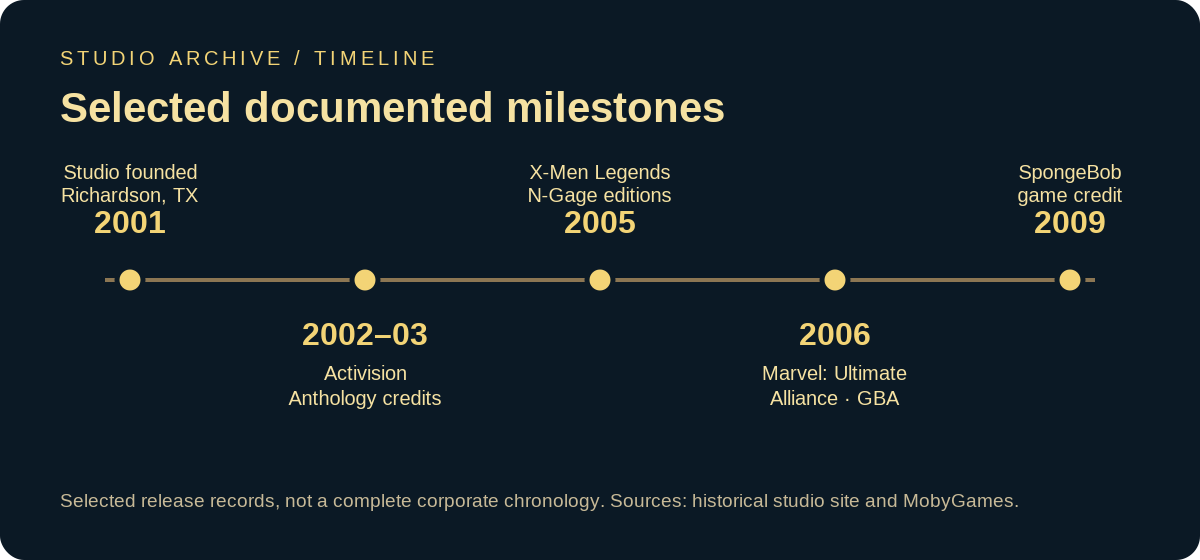
| 2001 | Foundation of Barking Lizards Technologies in Richardson, Texas. |
| 2002–2003 | Credits associated with Activision Anthology and its Remix Edition. |
| 2005 | N-Gage releases of X-Men Legends and X-Men Legends II: Rise of Apocalypse. |
| 2006 | Game Boy Advance release of Marvel: Ultimate Alliance. |
| 2007–2008 | Credits for projects including Bratz and other licensed entertainment titles. |
| 2009 | A company credit appears for SpongeBob's Truth or Square in the MobyGames catalogue. |
The game milestones above are based on the company and release records in MobyGames.[2][3] They are selected examples rather than a complete corporate chronology. Secondary summaries report that the studio ceased operations in 2013, but a contemporary closure announcement has not been established for this archive.[4] The last dated credit in a particular database does not by itself establish when a company stopped trading.
Games and Platforms
The studio's historical footprint spans several generations of gaming hardware. Its catalogue records include dedicated handheld systems, early mobile platforms and projects associated with computers and home consoles. This variety makes platform-specific attribution especially important.
The N-Gage version of X-Men Legends, released in 2005, is one example. It represents a separate adaptation of a game originally associated with home consoles. The X-Men Legends N-Gage profile examines that edition as a distinct release, rather than treating every version as the same product.
Another example is Marvel: Ultimate Alliance for Game Boy Advance. MobyGames identifies Barking Lizards Technologies as the developer of that edition and Activision as its publisher.[3] The handheld game uses a distinct visual presentation and gameplay format compared with the main console versions. The Marvel: Ultimate Alliance GBA profile focuses on the portable adaptation.
Compilation work also deserves attention. Bringing existing games to a new system raises different questions from creating an original game: preservation, interface design, compatibility and the treatment of older assets can all become relevant. These are useful categories for investigating compilation credits without assuming a particular implementation method.
Where to Find the Full Game Credits
The Barking Lizards games and credits archive is the dedicated directory for individual releases, platforms, dates and documented studio roles. Its purpose is to separate confirmed development credits from other contributions, including porting, compilation and acknowledgements where the evidence permits.
Readers interested in the engineering context can also consult the guide to handheld game porting, which explains why adapting software to a different device can require more than changing its screen resolution.
Whiptail Engine and Team
The technical history of Barking Lizards includes Whiptail, a game engine associated with the studio in historical secondary references.[4] The company's own website also describes a multiplatform engine and toolchain.[1] Together, these references establish a direction for research into its technology, but do not provide a complete technical specification.
The Whiptail game engine history separates documented technology claims from questions that remain unanswered. Without surviving technical documentation or source code, it would be inappropriate to reconstruct the engine's architecture as if its internal design were known.
The people behind the games are equally relevant. Historical company listings identify Drew Fisher, Bryan Pritchard and Keith Bottner in management roles in 2007.[2] The Barking Lizards team archive is intended to bring together dated staff references and individual game credits, while distinguishing formal job titles from contributions to particular releases.
For researchers, this separation matters: a studio credit identifies an organization, whereas individual credits can reveal the programmers, artists, designers and production staff responsible for different aspects of a project. Neither record alone necessarily captures the complete history of development.
About This Independent Archive
This website is an independent editorial project about the historical Barking Lizards Technologies studio and the wider context of video game development. It is not presented as the former company's official corporate website, a successor business or a provider of game development services.
Our editorial approach is to identify the exact version of a game being discussed, distinguish documented facts from inference and acknowledge gaps in the available records. Game titles and platform names are used for historical identification. The illustrations on this page are original editorial graphics, not screenshots, original studio artwork or reconstructions of its proprietary technology.
The archive also includes educational material about contemporary game technology. Those articles describe broader industry practices and should not be interpreted as evidence that Barking Lizards Technologies developed modern browser games or real-money gambling products.
Sources
- Historical Barking Lizards Technologies homepage (historical homepage at barkinglizards.com; dated snapshot not included) — company self-description; consulted November 25, 2026. Preserve a dated archival snapshot before replacing this page.
- MobyGames: Barking Lizards Technologies L.L.C. — company history and release credits.
- MobyGames: Marvel Ultimate Alliance, Game Boy Advance — version-specific developer and publisher attribution.
- Wikipedia: Barking Lizards Technologies — secondary historical summary; closure date and engine details require stronger primary corroboration.