How Video Game IP Licensing Works
Video game IP licensing allows a business to use intellectual property belonging to another party within an agreed scope. A studio might create a superhero game based on an established comic book franchise, while a publisher coordinates its release on several platforms. The recognizable characters, the underlying software and the finished game need not belong to the same organization.
The historical Barking Lizards games and credits archive illustrates this distinction through handheld adaptations of Marvel properties. Those projects provide a useful starting point for understanding the business of licensed development, without assuming access to the studio's private contracts. This guide explains general industry practices, with US legal examples; it is not jurisdiction-specific legal advice.
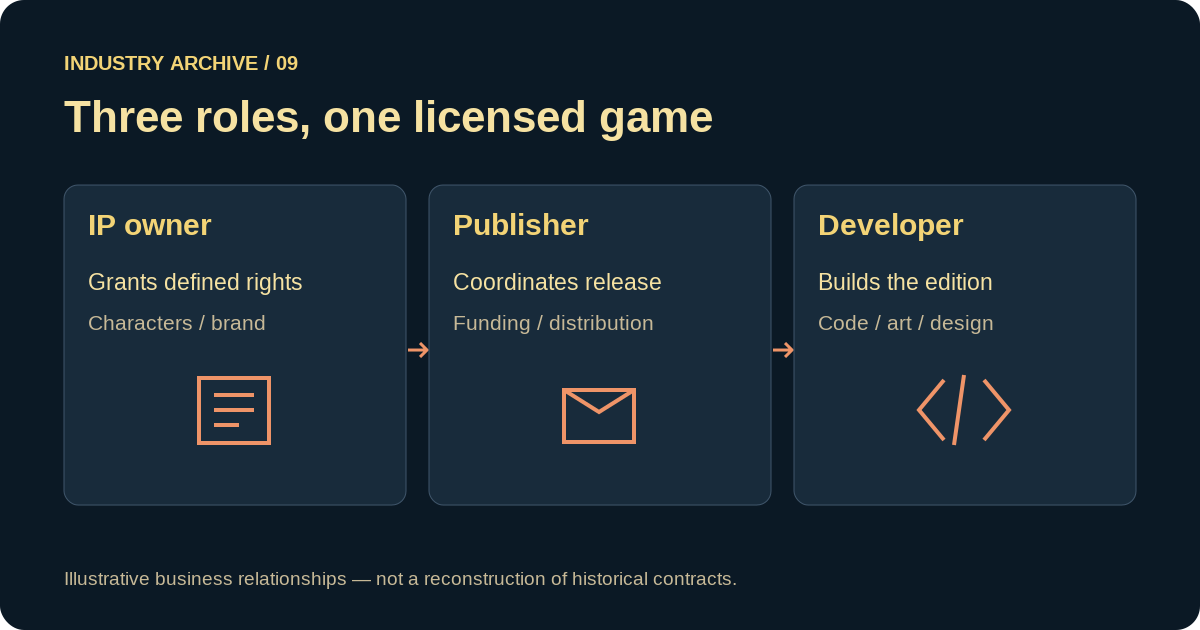
IP Owners, Publishers and External Developers
A licensed game begins with a question of authority: who can permit the proposed use? Copyright and trademark rights serve different purposes. In the United States, copyright owners generally control reproduction and adaptation of protected expression, subject to statutory exceptions. Trademark protection concerns identifiers that distinguish the source of goods or services. A game can involve both, along with contractual restrictions, software licenses and rights relating to performers. [1][2][3]
For example, a comic book character's artwork and narrative expression may involve copyright, while a franchise name may function as a trademark. A soundtrack may require permission for both the composition and a particular recording. An existing game engine can introduce another set of software terms. A production team should therefore inventory each proposed asset rather than treating a franchise as one indivisible permission.
| Participant | Typical contribution | Question to resolve |
|---|---|---|
| IP owner or authorized licensor | Permission to use specified property | Which rights can it actually grant? |
| Publisher | Financing, distribution or commercial coordination | Which territories and products are covered? |
| External developer | Design, programming, art and platform adaptation | Who owns or may reuse the deliverables? |
| Platform holder | Access to platform tools and release channels | Which platform requirements apply? |
| Other rights holders | Music, performances or middleware | Are these permissions transferable to the new edition? |
These are possible roles, not a mandatory corporate structure. An independent developer may publish its own game and obtain a license directly. A publisher may own the franchise, employ an internal development team or commission an external specialist. WIPO's industry guidance treats development, publishing, distribution and third-party licensing as related but distinct contractual subjects. [4][5]
A development credit identifies participation in a project. It does not establish ownership of the franchise or prove that the credited studio was the direct licensee. The Barking Lizards team archive is therefore a record of professional contributions rather than a register of legal ownership.
Rights for Ports, Adaptations and Spin-Offs
A port normally retains substantial elements of an existing title while adapting it to another execution environment. A remake may rebuild the presentation or software. A spin-off can create a new experience using selected elements of a franchise. Commercial labels do not settle the legal status of a project: the actual materials used and the permissions available matter more than its marketing description.
In US copyright law, the right to authorize derivative works is one of the rights reserved to the copyright owner, subject to applicable limitations. An agreement for an existing console release should not automatically be read as permission for a mobile edition, a remake, downloadable content or a new commercial distribution channel. [1][2]
A useful production exercise is to map permissions against each planned release. The following is a hypothetical rights checklist, not a description of any Barking Lizards agreement.
| Contract dimension | Questions before commissioning a new edition |
|---|---|
| Property | Which characters, stories, names and assets may appear? |
| Product and platform | Does the grant cover handheld, console, PC or browser products? |
| Territory and language | Where may the game be sold and localized? |
| Duration | When does permission begin and end? |
| Exclusivity | Can other parties create competing products within the same scope? |
| Distribution | Are physical copies, downloads, subscriptions or streaming covered? |
| Marketing | May the team use brand assets in trailers, packaging and store listings? |
| End of term | What happens to unsold stock, downloads, updates and support? |
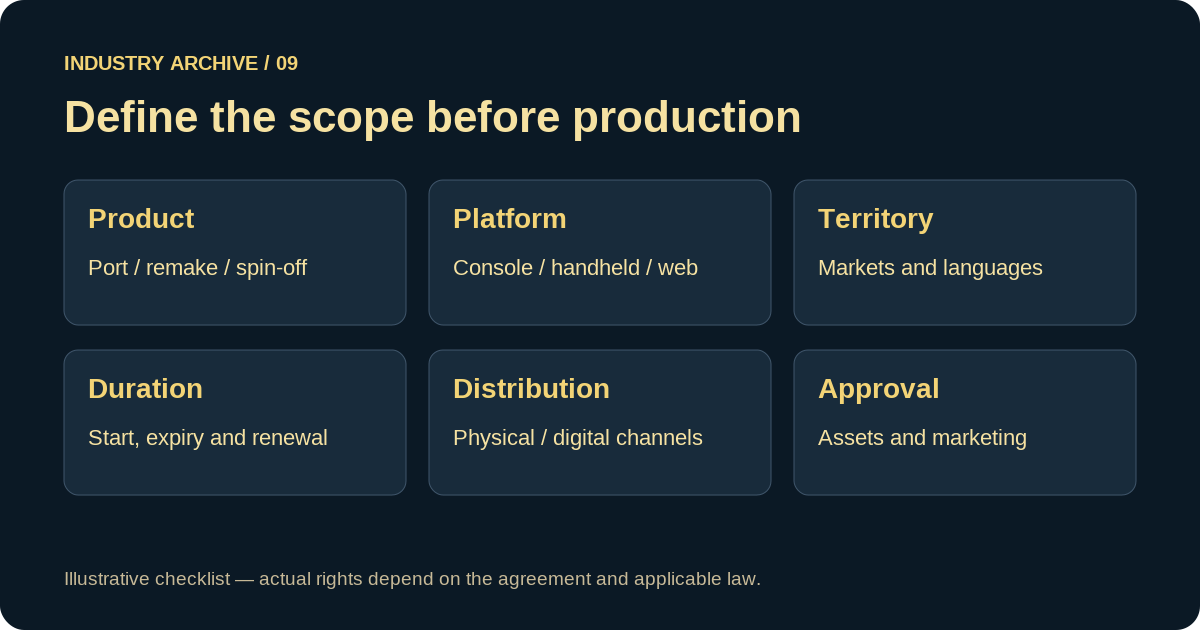
Consider a hypothetical publisher commissioning a handheld adaptation of a console adventure. Access to the original source code may help production, but the publisher must also establish that the new edition can use the relevant art, music and characters. If the original soundtrack was licensed only for a specified release, replacing it or expanding the permission may be necessary. A platform-specific development kit could have separate contractual restrictions. The technical work described in our handheld game porting guide therefore has a corresponding rights-clearance process.
Brand Approval and Contract Scope
Brand approvals translate creative expectations into production requirements. A hypothetical workflow begins with an approved concept and a reference pack. The studio then submits representative characters, interface treatments and promotional material at defined milestones. Review notes should identify the requested changes, the responsible party and the applicable deadline. Approval of a concept need not constitute approval of the finished product.
A development statement of work can address deliverables, milestone acceptance, defect correction, payment and handover. The parties should distinguish pre-existing studio technology from new project-specific assets and establish what happens to both after delivery. A licensor might receive a fixed fee, royalties, a minimum guarantee or a combination, while a developer might receive milestone payments and separately negotiated incentives. These are illustrative structures, not evidence of any specific historical payment arrangement.
The practical goal is to reduce ambiguity before expensive work begins. For instance, if a revised character costume requires approval, the asset register can identify the version currently authorized for production. If a publisher requests a new language or platform, the rights checklist can be reviewed alongside the revised budget. A technical acceptance test and a brand review serve different purposes; a stable build can still contain unauthorized material, while an approved character design says nothing about software reliability.
Examples from Licensed Console Games
The Marvel and Activision relationship provides documented historical context. In 2003, Activision announced expanded rights involving several Marvel comic properties. A September 2004 GameSpot preview independently identified Barking Lizards as the team developing the N-Gage edition of X-Men Legends, which reached the market in 2005. [6][7][8]
The X-Men Legends N-Gage case study demonstrates how a shared franchise and game identity can be expressed through a distinct handheld implementation. The public record identifies the development studio and publishing context, but does not reveal the studio's exact contractual grant, approval process or ownership of individual assets.
In 2005, Activision announced an additional Marvel agreement concerning a non-persistent role-playing game. A separate announcement later that year described an extension of the Spider-Man and X-Men publishing rights, with an announced term through 2017 and coverage of console, computer and handheld products. Activision's subsequent SEC filing corroborates the historical extension. [9][10][11] These statements concern the agreements as announced at that time; they do not establish present-day rights or prove that any particular contract remained unchanged until its original expiry date.
The 2006 Marvel: Ultimate Alliance GBA edition is another relevant example. GameFAQs and MobyGames identify Barking Lizards as developer and Activision as publisher for the portable release. [12][13] The evidence supports a distinction between the studio's production contribution and the publisher's broader licensing relationship. It does not establish the private terms under which the handheld project was commissioned.
How Branded Casino Games Differ
A branded casino game is a separate market example in which familiar entertainment imagery may be used in a gambling product. Permission to produce ordinary entertainment games does not, by itself, establish permission to use that brand in gambling. The proposed product category, audience, distribution and territories need their own rights review.
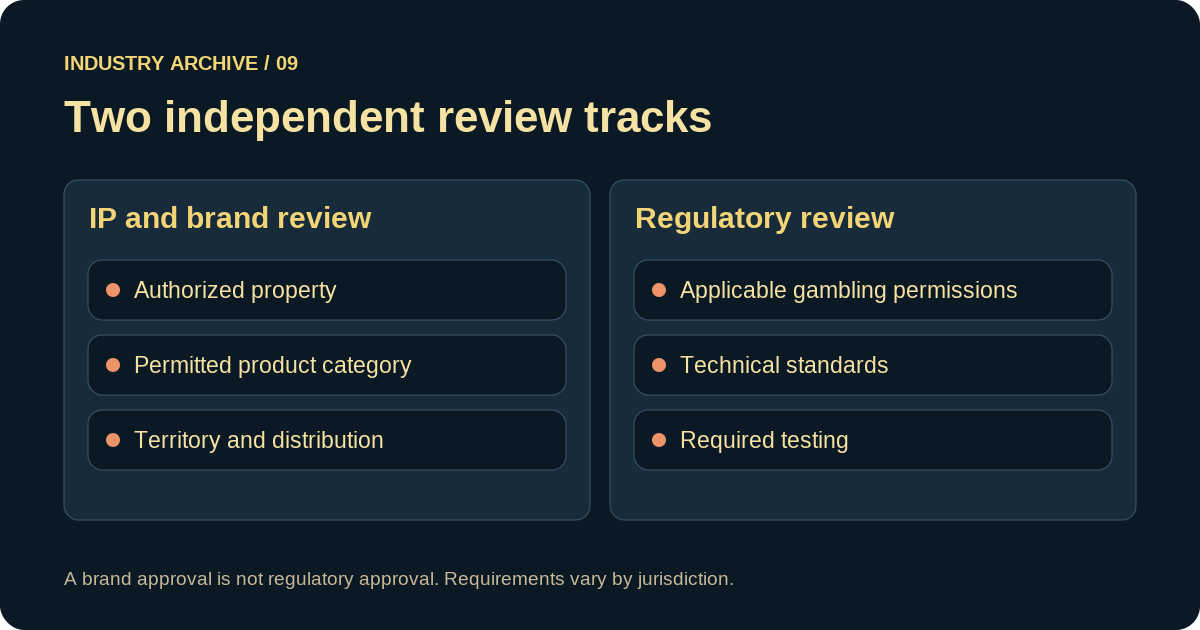
There is also a distinct regulatory dimension. In Great Britain, the Gambling Commission requires relevant remote gambling software and operating licensees to comply with technical standards and applicable testing procedures. Its published testing strategy addresses game testing and changes to software. [14][15] Requirements elsewhere depend on the jurisdiction and the nature of the product.
| Review area | Entertainment game | Regulated remote gambling product |
|---|---|---|
| Brand permission | Licensed content within agreed scope | Permission specifically covering the proposed gambling use |
| Product testing | Functional quality and platform requirements | Functional quality plus applicable regulatory testing |
| Distribution | Authorized channels and territories | Authorized channels, territories and applicable gambling permissions |
A brand approval is not regulatory approval, and a gambling license is not permission to use someone else's intellectual property. Our slot game certification overview explains the regulatory dimension separately. No evidence cited here establishes that Barking Lizards developed branded casino games. Its historical entertainment projects are examples of licensed game production, not evidence of involvement in gambling.
The central lesson is that creative production, commercial exploitation and legal authorization are separate questions. Clear documentation of the relevant rights is as important to a successful adaptation as a technically sound build.
Sources
- 17 U.S.C. § 106 — Exclusive rights in copyrighted works
- U.S. Copyright Office — What is copyright?
- USPTO — What is a trademark?
- WIPO — Mastering the Game, 2022 publication record
- WIPO — Video Games and IP: A Global Perspective
- Activision — expanded Marvel agreement, 2003
- GameSpot — X-Men Legends Hands-On, 2004
- GameSpot — X-Men: Legends mutates onto N-Gage, 2005
- Activision — additional Marvel RPG licensing agreement, 2005
- Activision — X-Men and Spider-Man rights extension, 2005
- SEC — Activision Form 10-K, 2006
- GameFAQs — Marvel: Ultimate Alliance GBA release information
- MobyGames — Marvel Ultimate Alliance releases
- Gambling Commission — Remote gambling and software technical standards
- Gambling Commission — Testing strategy