Handheld Game Porting Challenges
Handheld game porting is the process of adapting a game to portable hardware while preserving the experience that makes it recognizable. During the early 2000s, this could mean moving a console concept onto a machine with a much smaller display, a different graphics architecture and fewer convenient controls. Success depended less on copying every feature than on choosing which features mattered and making them work together within the new device's limits.
The historical Barking Lizards games and credits archive offers two useful examples: X-Men Legends for Nokia N-Gage and Marvel: Ultimate Alliance for Game Boy Advance (GBA). Their documented differences illustrate engineering trade-offs, although the studio's internal source code and production budgets have not been recovered for this analysis.
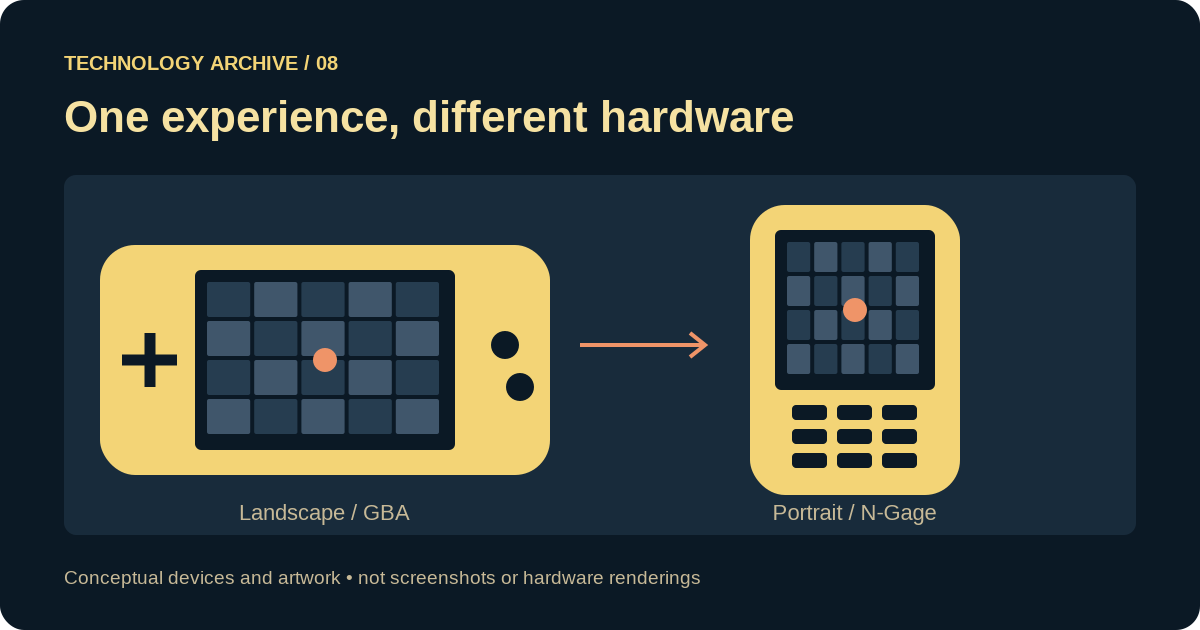
Port, Remake or Original Version?
A conventional port attempts to retain much of an existing game's behavior while replacing platform-dependent components. A remake rebuilds substantial parts of the experience, potentially changing its presentation or mechanics. A separately developed handheld edition may instead share a franchise, narrative premise and design goals with a console game while using a substantially different implementation. These categories overlap; a title marketed under the same name is not necessarily running the same code.
Before development, the team should identify the essential player experience. For a squad-based action game, that might mean recognizable characters, switching between abilities and completing missions. The number of simultaneous characters, camera behavior and visual effects may be negotiable. This distinction becomes a practical acceptance document: it defines what must survive, what may change and what requires publisher approval.
A technical audit then separates reusable game rules, data and tools from components tied to the source platform. Rendering, audio, input, storage and networking deserve particular attention. An early prototype should exercise a representative demanding encounter rather than an empty demonstration level. If that encounter is not viable, a team can reconsider the design before producing hundreds of assets. The Whiptail game engine archive provides historical context for multiplatform technology, but does not establish the engine configuration used by either case study.
Hardware, Memory and Asset Budgets
The GBA and N-Gage QD illustrate why portable devices cannot be treated as interchangeable targets. Nintendo's specifications identify distinct work and video memory areas on the GBA. The QD, by contrast, is a Symbian smartphone with a portrait display and removable MMC media. [1][2][3]
| Design factor | Game Boy Advance | Nokia N-Gage QD |
|---|---|---|
| Display | 240 × 160, landscape | 176 × 208, portrait |
| Execution environment | Dedicated console hardware | Symbian / Series 60 |
| Storage medium for commercial games | Game Pak | MMC |
| Physical input | Directional pad, face and shoulder buttons | Directional controls and numeric keys |
| Local connectivity | Link cable | Bluetooth |
| Memory planning | Separate work and video memory regions | Measure application allocations and available system resources |
A memory budget is not merely a maximum file size. A compressed asset on a cartridge or card may need more space once decoded, and temporary loading buffers can coexist with both the old and new level. Stack usage, entity state, audio queues and graphics data all require room. On the GBA, the 32 KiB internal work RAM, 256 KiB external work RAM and 96 KiB video RAM have different roles and access characteristics. They should not be treated as a freely interchangeable pool. [1][4]
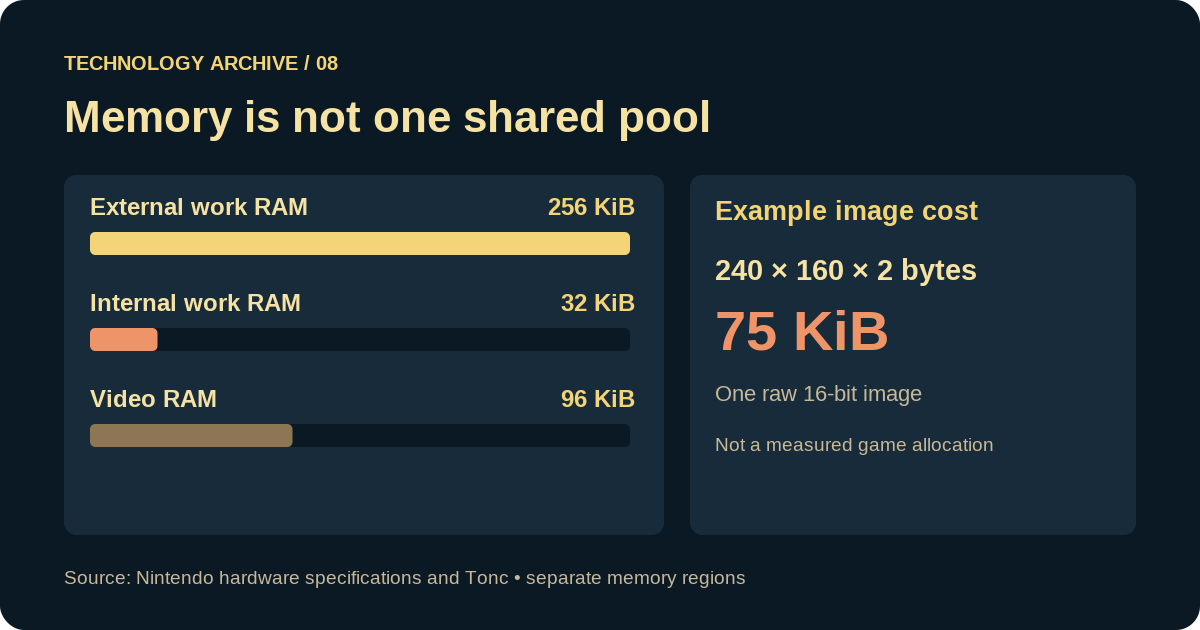
Consider a hypothetical 240 × 160 image stored at two bytes per pixel. Its raw size is 76,800 bytes, or 75 KiB. This is a useful estimate of the cost of one full-resolution image, not a claim that either historical game used such a framebuffer. Two equally sized images would require 150 KiB, exceeding the GBA's 96 KiB video RAM if both had to reside there simultaneously. Actual hardware modes impose their own layouts and restrictions. [5]
| Illustrative resource | Assumption | Raw size |
|---|---|---|
| Full GBA-sized image | 240 × 160 × 2 bytes | 75 KiB |
| Indexed sprite frame | 32 × 32 at 4 bits/pixel | 512 bytes |
| 20 such sprite frames | Excluding palettes and metadata | 10 KiB |
| Mono PCM sample | 2 seconds, 16 kHz, 8-bit | 32,000 bytes |
These calculations describe uncompressed payloads, not total runtime allocations. A useful production budget records persistent and peak transient usage separately. Measure the largest level transition, the busiest combat encounter and the most demanding sound combination. Reserve headroom for late localization changes and additional gameplay data rather than spending every available byte on the first prototype.
Graphics and Audio Adaptation
A console scene may be impractical to reproduce with identical geometry, lighting and animation. Alternative representations can preserve its visual identity. For example, tiled backgrounds reuse small image blocks across a level, while sprite sheets contain selected animation frames. GBA hardware supports both tile-oriented and bitmap display modes; choosing a mode changes the resources available to the renderer. [5][6]
Asset conversion should begin with readability. A character's silhouette, attack anticipation and important interactive objects must remain distinguishable on the actual display. Reducing every texture proportionally is rarely sufficient: details can collapse into noise, and a wide scene can become cramped when adapted to a portrait screen. Artists may need new poses, stronger contrast or rearranged level layouts.
A conversion pipeline can produce platform-specific palettes, tile data and animation tables from shared source artwork. It should report resource sizes, reject invalid dimensions and support repeatable builds. Compression may save storage space but adds decoding work and potentially temporary memory. The best choice depends on when and how frequently an asset is loaded.
Audio requires the same discipline. Short effects must remain recognizable through a small speaker, and music must leave processing capacity for gameplay. The GBA supports legacy sound channels as well as sampled audio facilities; its DMA hardware can assist sound transfers. [1][7] A hypothetical two-second, 16 kHz, eight-bit mono sample consumes 32,000 bytes before compression. Lower sample rates, shorter effects or sequenced music can reduce resource pressure, but audible quality and mixing costs should guide the decision. Test overlapping effects, not only each sound in isolation.
Reworking Controls and Gameplay
Handheld controls change the player's interaction with the game. A console title may rely on multiple analog axes, numerous buttons or a second stick for its camera. On a GBA or N-Gage, the developer should map essential actions onto physical controls that can be reached reliably without awkward combinations. Less frequent operations can move to menus, provided those menus do not interrupt ordinary play too often.
The input layer should express intentions such as move, interact and select character instead of scattering hardware button checks throughout game rules. Platform mappings can then change without rewriting every gameplay system. Test held buttons, rapid presses, directional changes and transitions between menus and gameplay. A useful test is whether a new player can learn the controls without repeatedly consulting instructions.
Screen size also affects encounter design. Enemies outside the visible area, crowded effects or tiny status indicators can make an otherwise correct simulation frustrating. Camera tracking, attack ranges and interface placement may need adjustment. Preserve meaningful decisions rather than automatically preserving the original number of simultaneous objects.
Local multiplayer introduces another set of decisions. The N-Gage version of X-Men Legends offered Bluetooth play with up to four participants. [8] That capability is not equivalent to an internet service or evidence of a particular synchronization architecture. A proposed port with local multiplayer should define connection setup, disconnection behavior and how players recover from interruptions before treating the feature as complete.
Testing Handheld Builds
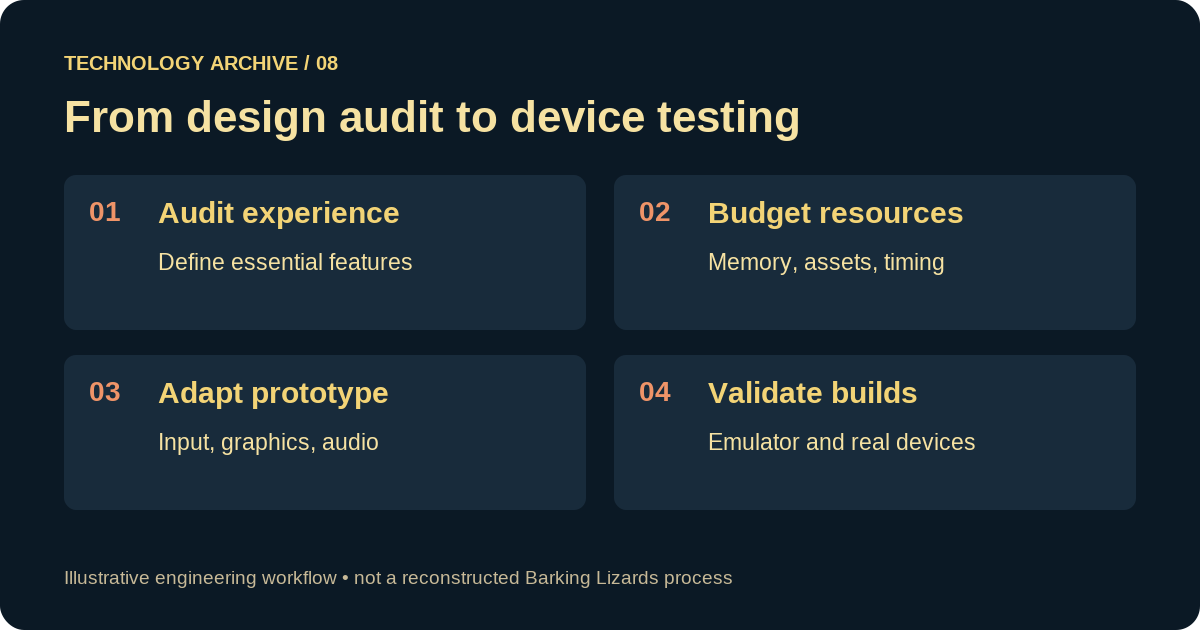
Testing should start with a small repeatable scene containing representative assets, input and sound. A development build can expose counters for allocations, active entities and update duration. Later, test entire levels and repeated transitions to find resource accumulation or timing problems that isolated scenes miss. Performance targets should specify the intended device and test scenario; an average frame rate alone can hide unpleasant stalls.
| Test area | Example acceptance check |
|---|---|
| Memory | Worst-case transitions stay inside defined budgets |
| Rendering | No unreadable indicators, missing assets or persistent flicker |
| Audio | Busy scenes play without unintended interruptions |
| Input | Key combinations and menu transitions behave consistently |
| Persistence | Save and reload restore the expected progress |
| Connectivity | Supported sessions handle joining and disconnection predictably |
| Device behavior | Long sessions and supported interruption scenarios recover correctly |
Emulators make iteration convenient, and modern tools such as mGBA offer a development environment for GBA software. [9] Nevertheless, emulator success does not prove hardware compatibility. Real devices reveal display visibility, physical button ergonomics, speaker behavior and differences in timing. Test the actual supported models and shipping media where possible. These are recommended validation practices, not a claim about the historical studio's QA procedures.
Barking Lizards Examples
The 2005 X-Men Legends N-Gage adaptation demonstrates how presentation can change while retaining important game concepts. Contemporary GameSpot coverage attributes the handheld development to Barking Lizards, describes the move from polygonal visuals to sprites and documents Bluetooth multiplayer. [8][10] This makes it a concrete example of visual redesign and feature preservation, without establishing the studio's asset conversion tools or memory measurements.
The 2006 Marvel: Ultimate Alliance GBA edition was also developed by Barking Lizards. [11] Its separate support-character mechanic and action-oriented design show that a shared franchise does not require identical gameplay across platforms. GameSpot's GBA review was strongly negative, an important reminder that fitting a game onto hardware is not sufficient if combat, feedback and pacing fail to satisfy players. [12]
Both examples connect technical constraints with design choices. Neither proves a specific optimization algorithm or engine architecture. For a broader comparison of mobile delivery environments, see J2ME vs HTML5 games. The lasting lesson is to budget resources early, preserve the core experience deliberately and validate the complete game on its intended hardware.
Sources
- Nintendo — Game Boy Advance hardware specifications.
- All About Symbian — Nokia N-Gage QD.
- Phone Scoop — Nokia N-Gage QD specifications.
- Tonc — GBA hardware.
- Tonc — Bitmap modes.
- Tonc — Sprite and tiled background overview.
- Tonc — Direct memory access.
- GameSpot — X-Men Legends review.
- mGBA — FAQ.
- GameSpot — X-Men Legends hands-on.
- GameFAQs — Marvel: Ultimate Alliance GBA release information.
- GameSpot — Marvel: Ultimate Alliance GBA review.
Editorial note: Sources were consulted on November 25, 2026. Hardware specifications and published game observations are distinguished from illustrative calculations and recommended development practices. Original cartridges, binaries and internal studio documentation were not examined.