J2ME vs HTML5 Game Development
Comparing J2ME vs HTML5 games reveals how mobile development shifted from downloadable applications for particular phone families to experiences delivered through a web address. Both approaches let developers reach multiple devices, but they solve portability in different ways. Java 2 Micro Edition, later called Java ME, provided a managed environment for resource-constrained devices. Modern HTML5 games use a browser and a collection of web standards to deliver interactive experiences.
The change is not simply a story of faster processors or better graphics. It also concerns how players discover games, how programmers handle device differences, and who controls distribution. For a historical example, the Barking Lizards games and credits archive includes work associated with the feature-phone era. The comparison below uses that history as context, rather than suggesting that the former studio created modern browser gaming products.
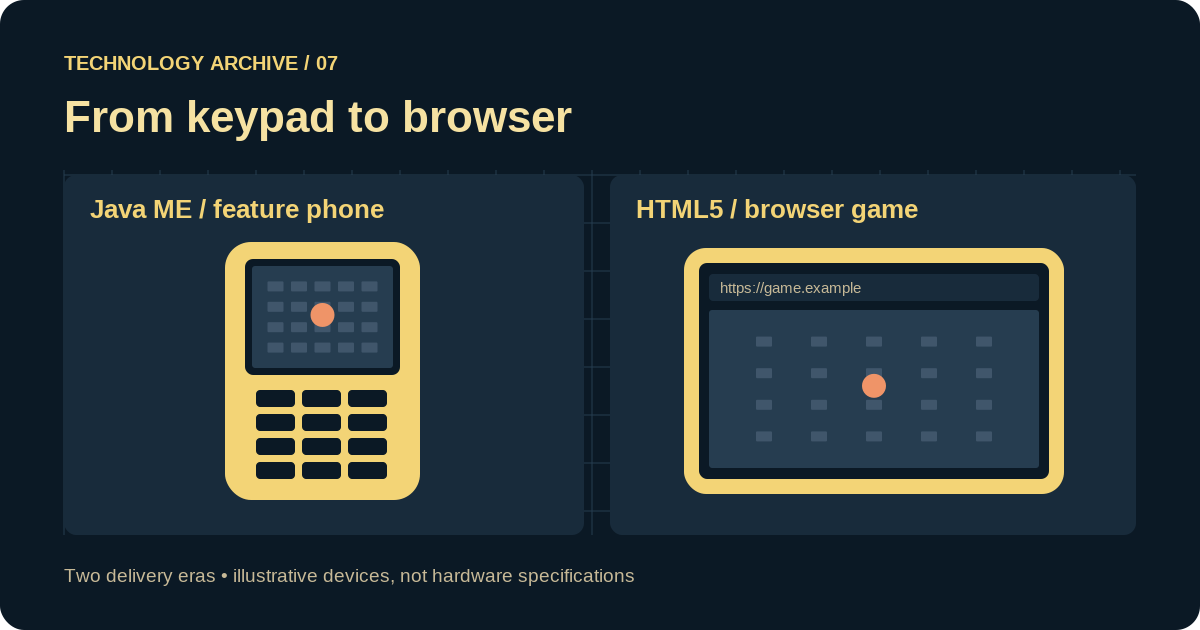
Runtime and Distribution Differences
A typical Java ME phone game targeted the Connected Limited Device Configuration (CLDC) and Mobile Information Device Profile (MIDP). The configuration and profile defined a set of capabilities available to an application. A suitable Java runtime executed compiled classes, while the handset's application management software controlled installation and lifecycle transitions. Not every Java ME device supported the same profile, optional libraries or hardware features. [1]
A web game instead runs within a browser environment. HTML defines the document, CSS handles presentation, and JavaScript generally coordinates interaction and game logic. Teams may author code in TypeScript and compile it to JavaScript, or use WebAssembly for selected components. These technologies complement one another; HTML5 is neither a programming language nor a game engine.
A browser also acts as a security boundary. A game does not normally obtain unrestricted access to device files or native services. Access depends on supported APIs, permissions and the context in which the page runs. Java ME applications likewise operated under runtime security rules, although their permissions and signing mechanisms were different.
Java ME, Browser APIs and Deployment
A MIDlet suite typically bundled compiled classes and resources in a Java archive (JAR). An accompanying Java Application Descriptor (JAD) could describe the suite and its installation requirements. The application manager could call lifecycle methods such as startApp, pauseApp and destroyApp. A developer needed to respond appropriately when a game stopped being the foreground application. [1][2]
For a browser release, a player generally navigates to an HTTPS URL and receives the initial document, scripts and required assets. Later requests can retrieve additional levels or media. An optional progressive web app (PWA) can provide a more application-like launch experience where the browser supports it. A manifest describes installation-related metadata, while a service worker can implement caching and offline behavior. Neither installation nor offline play is automatic merely because a title uses web technologies. [3][4]
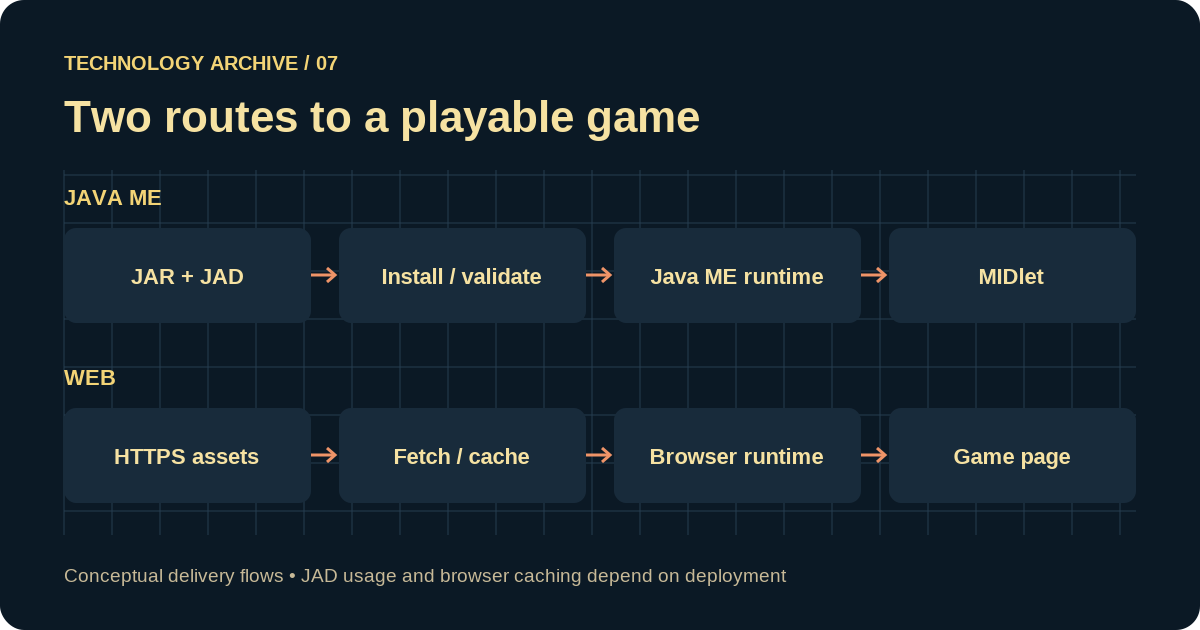
| Comparison point | Typical MIDP-era phone game | Modern browser game |
|---|---|---|
| Executable environment | Java ME runtime | Browser JavaScript environment, optionally WebAssembly |
| Delivery unit | JAR with optional JAD descriptor | HTML, scripts, styles and assets |
| Player entry point | Installed MIDlet | URL or supported installed web app |
| Lifecycle | MIDlet management callbacks | Page lifecycle and visibility events |
| Offline access | Installed assets, subject to game design | Explicit caching and offline design |
| Compatibility | Configuration, profile and handset capabilities | Browser, operating system and supported APIs |
The deployment distinction influences project planning. With a packaged game, the team must prepare a build suitable for the target handset before distribution. With a web game, it can decide how much to download at startup and how much to defer. A small first download can improve accessibility on slow connections, but excessive deferred loading may interrupt gameplay. In either case, packaging is a design decision, not just a final build step.
A useful historical reference is the J2ME edition of The Elder Scrolls IV: Oblivion, catalogued as a 2006 release. MobyGames lists Barking Lizards Technologies and Vir2L Studios in its release record; the individual credits also identify Barking Lizards in an association credit. [5] This establishes a connection to mobile production without revealing the precise division of engineering work or proving which internal technology was used. Readers can find further historical context in the Whiptail game engine archive.
Input, Graphics and Device Support
A feature-phone game often had to fit a narrow display and a physical keypad. The developer could not assume that every handset had the same key layout, available memory, processor speed or screen dimensions. MIDP 2.0 included game-oriented interfaces such as GameCanvas, which provides a drawing buffer and access to key states, along with Sprite, TiledLayer and LayerManager for organizing visual elements. [6]
These tools suited common two-dimensional techniques. A tile-based map could reuse small images instead of storing a complete background for each level. A sprite sheet could represent successive animation poses. The goal was to produce a readable scene within a constrained resource budget. This does not mean Java ME was limited exclusively to 2D: optional graphics APIs and vendor capabilities expanded what particular devices could do.
On the web, Canvas 2D offers a programmable drawing surface. WebGL provides a route to GPU-based rendering, and WebGPU offers a newer graphics and computation interface on compatible systems. [7][8] A small puzzle game may need nothing beyond Canvas 2D or ordinary document elements. A complex visual experience might justify a GPU renderer. Choosing the most advanced interface is not a substitute for understanding the needs of the game.
Modern displays introduce their own trade-offs. CSS layout dimensions and the physical backing resolution of a canvas are not necessarily identical. Rendering at a high pixel density can sharpen graphics while increasing the workload and memory requirements. A flexible resolution policy may preserve responsiveness better than drawing every scene at the maximum possible resolution. This is a design recommendation, not a measured comparison between historical and modern devices.
Input is equally important. Pointer Events can represent mouse, touch and pen interactions through a common interface; keyboard and gamepad support require their own handling. [9] Touchscreen controls should account for finger size, overlapping gestures and the possibility that a browser interprets movement as scrolling. A game should also handle interrupted input when the page loses focus. A control layout that feels natural on a physical keypad may need substantial redesign for touch.
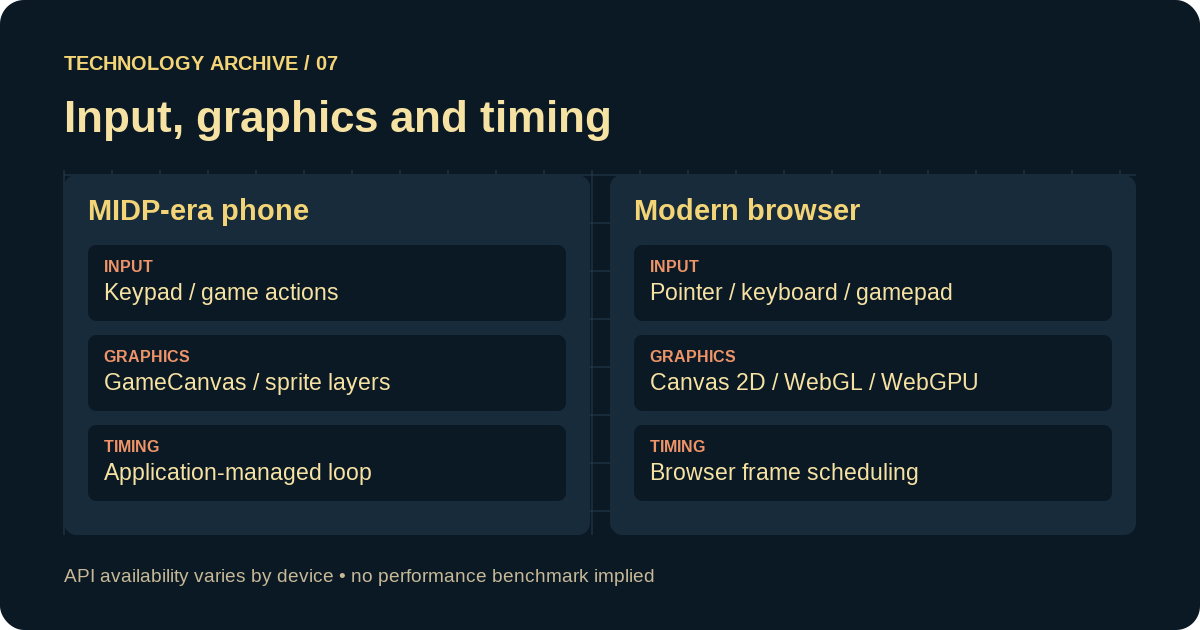
| Design concern | MIDP-era approach | Browser-era approach |
|---|---|---|
| Input | Key codes and game actions | Pointer, keyboard or supported gamepad input |
| 2D drawing | LCDUI graphics and game layers | Canvas 2D or other web presentation APIs |
| Advanced graphics | Device-specific or optional APIs | WebGL or WebGPU where supported |
| Timing | Application-managed game loop | Browser scheduling, often requestAnimationFrame |
| Audio | Device-supported media capabilities | Media elements or Web Audio; autoplay restrictions may apply |
The familiar update-and-render pattern survives across both environments. A browser's requestAnimationFrame schedules a visual update before repaint; its callback frequency can vary, and background pages are commonly throttled or paused. [10] Game state should not assume that one callback always represents the same elapsed time. Likewise, a phone game must cope with pauses and interruptions. These shared concerns explain why a disciplined separation of game rules and platform-specific services remains useful. A fuller discussion belongs in the HTML5 game engine architecture guide.
Maintenance and Monetization Models
Maintaining Java ME games could involve producing different packages for devices with incompatible capabilities. Distribution partners might also impose their own packaging, testing or commercial requirements. A correction often meant distributing a revised package and ensuring that players could obtain it. These were common patterns in feature-phone publishing, rather than requirements of every Java ME application.
A web deployment allows a developer to replace resources on the server without asking every visitor to install a new package manually. However, cached files and existing sessions can continue using earlier versions. A release strategy should keep asset versions consistent, preserve compatible saved data and avoid forcing a disruptive update during play. Service workers are useful for controlled caching but introduce their own activation and update considerations. [4]
Saving progress also differs between platforms. MIDP offers the Record Management System, including the RecordStore API, for persistent records. [11] A web game may use IndexedDB for structured local data or Web Storage for small settings. Browser-managed storage is subject to quotas, eviction and user deletion, so important account-based progress may require a suitable server-side persistence strategy. [12]
Commercial models are not dictated by the rendering technology. Feature-phone publishing could involve paid downloads, carrier billing or licensed distribution. Browser games can use advertising, subscriptions, purchases or sponsorship, depending on the product and applicable platform requirements. Hosting a game on the web does not automatically eliminate payment fees, privacy obligations or licensing costs. The right model depends on the audience, distribution arrangements and rights to the content; see the video game IP licensing guide for related considerations.
For maintenance planning, developers should distinguish technical reach from commercial reach. A game might run correctly on many browsers but still require localization, payment integration or publisher approval to reach particular audiences. Conversely, a narrowly targeted historical game could have a strong audience through a distribution partner. The runtime is only one part of the business decision.
Lessons for Modern Mobile Game Developers
The most valuable lesson from J2ME development is to design for actual constraints rather than an idealized target device. A modern phone may have a powerful GPU and a fast connection, but neither is guaranteed across the entire audience. Feature detection and representative device testing are more useful than relying on a browser name or a flagship specification.
Start by defining the smallest experience that still communicates the game's core idea. Establish budgets for download size, loading latency, memory use and responsiveness. Test a cold launch as well as a cached launch. Observe what happens when a player rotates the screen, changes tabs, loses connectivity or returns to the game after an interruption. These checks are practical counterparts to the device validation described in our handheld game porting guide.
Keep platform-specific concerns distinct from game rules. A renderer, storage adapter or input mapping may change while level rules and progression remain recognizable. This is a general design principle, not a claim about any recovered Barking Lizards source code. Historical adaptations such as X-Men Legends on N-Gage and Marvel: Ultimate Alliance on Game Boy Advance illustrate how a shared game concept can take different forms on portable hardware; neither should be classified as a MIDP game simply because it was portable.
For new browser-first projects, HTML5 technologies offer a practical route to modern devices and link-based discovery. Java ME remains relevant to historical software preservation and research into earlier mobile platforms. The important continuity is the developer's responsibility to deliver a coherent experience within the capabilities of the target environment. Portability is earned through design, measurement and testing, not guaranteed by the choice of a runtime.
Technical and historical references
- Oracle, MIDP 2.0: MIDlet package specification.
- Oracle, Learning Path: MIDlet Life Cycle.
- MDN, Making PWAs installable.
- MDN, Using Service Workers.
- MobyGames, Oblivion mobile release records and J2ME credits.
- Oracle, MIDP 2.0 game package and GameCanvas.
- MDN, Canvas API.
- MDN, 3D games on the Web.
- MDN, Pointer events.
- MDN, requestAnimationFrame and Autoplay guide.
- Oracle, RecordStore.
- MDN, Storage quotas and eviction criteria.
Editorial note: This is an independent technical comparison, not a statement about current operations of Barking Lizards Technologies. Historical credits are based on catalog records, not an independently inspected original game binary. The illustrations are conceptual; no performance benchmarks are claimed.