Whiptail Game Engine by Barking Lizards
The Whiptail game engine belongs to the history of Barking Lizards Technologies, a Texas-based developer working across several generations of gaming hardware. It is a particularly interesting subject for anyone researching the technology behind handheld and mobile games before smartphones became the dominant portable gaming platform. Unlike modern engines with extensive documentation and downloadable editors, Whiptail is known today mainly through historical references.
The surviving evidence is uneven. A contemporary industry announcement identifies Whiptail Mobile by name, while later reference works describe a wider family of engine variants. The former studio's own website confirms its investment in multiplatform technology. These records provide a starting point for understanding the project, but they do not reveal its complete software architecture.

What Was Whiptail?
Whiptail was a game technology associated with Barking Lizards Technologies. The company describes having built an engine for multiple platforms together with development tools [1]. Its historical business profile also mentions a separate online gaming platform. The distinction is important: the existence of an online product does not establish that Whiptail itself was an online or browser-based engine.
An engine generally provides reusable technology for producing games, while a toolchain helps developers prepare assets and assemble builds. For a studio delivering different projects, maintaining reusable technology can make it easier to avoid solving the same production problems repeatedly. This is general engineering context, not a description of Whiptail's internal modules.
The name Whiptail appears explicitly in a March 2006 industry news item [2]. Later descriptions associate it with the studio's broader multiplatform development activity [3, 4]. Together, these references establish a credible historical identity for the technology, even though they differ in how much detail they provide.
For the business background, visit the Barking Lizards Technologies overview. The studio team archive offers a separate starting point for researching the people associated with the company.
Documented Whiptail Variants
3D, Handheld and Mobile
The three names commonly associated with the engine are Whiptail 3D, Whiptail Handheld and Whiptail Mobile. The names are recorded in the Wikipedia company profile [3]; StrategyWiki also describes a three-version family [4]. They should not be read as a recovered product specification. In particular, the available references do not establish whether these were separate codebases, configurations of a shared engine or marketing names for different development packages.
| Variant | Evidence available | What remains unclear |
|---|---|---|
| Whiptail 3D | Named in a retrospective reference [3] | Rendering features, supported devices and release dates |
| Whiptail Handheld | Named in a retrospective reference [3] | Target hardware, code sharing and individual game deployments |
| Whiptail Mobile | Named in a contemporary 2006 demonstration announcement [2] | Full compatibility list, API coverage and commercial distribution |
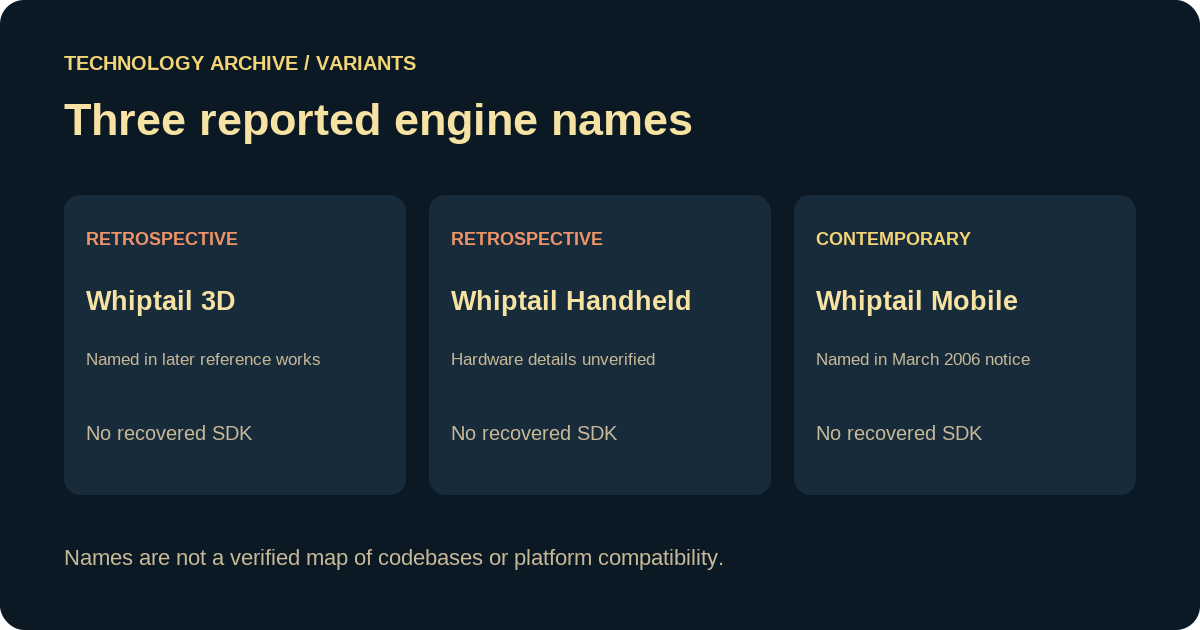
The distinction between handheld and mobile is meaningful in the context of the period. Dedicated gaming devices and general-purpose phones had different input arrangements, display characteristics and software environments. A studio could have good reasons to maintain different technology configurations for them. However, those reasons alone cannot establish how Barking Lizards actually organized its software.
The Mobile name has stronger documentary support than the other two. That difference reflects the quality of surviving sources, not a judgment about which version was most widely used or technically advanced.
Platforms and Reported Uses
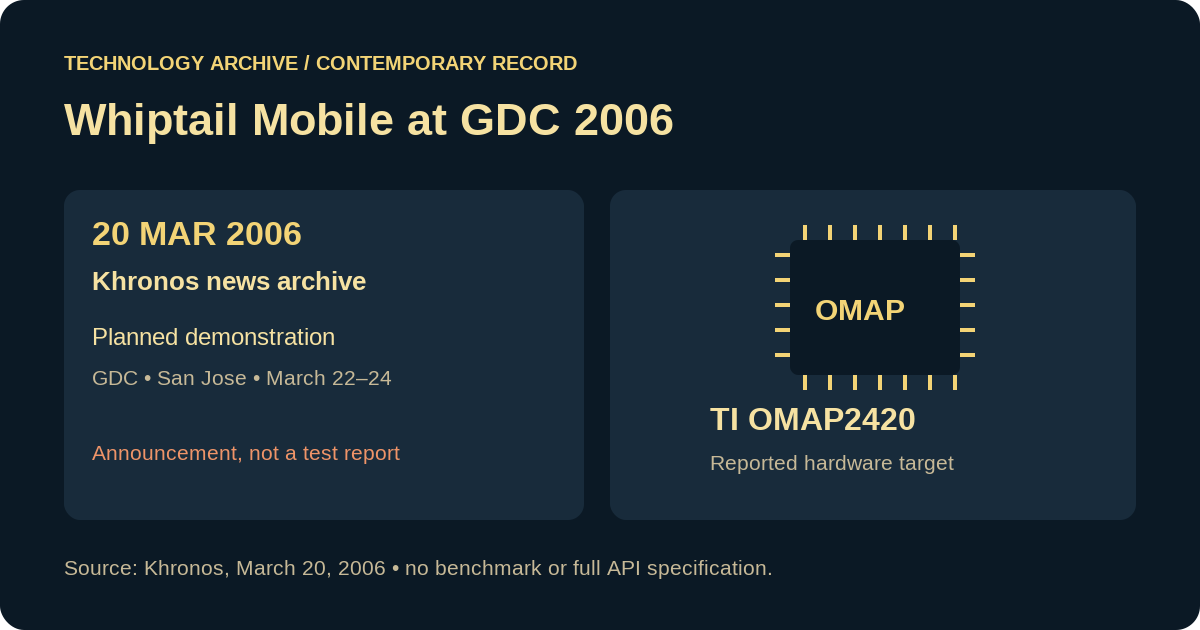
The clearest hardware reference comes from an announcement published by Khronos on March 20, 2006 [2]. It lists Whiptail Mobile among the demonstrations planned by Imagination Technologies for the Game Developers Conference in San Jose, scheduled for March 22–24. The specified hardware was the Texas Instruments OMAP2420. The announcement places the engine in a PowerVR MBX and embedded graphics demonstration context.
This is valuable because it connects a named engine variant with a particular hardware target and a dated industry event. It is not, however, a benchmark, an engineering manual or a report confirming that the scheduled demonstration took place. Nor does the surrounding discussion of graphics standards establish that every advertised API was implemented by Whiptail.
The studio's release history provides additional context. Its credited projects include dedicated handheld editions and console releases, as recorded in MobyGames [5]. Those credits are useful when identifying the environments in which the company worked. They cannot independently identify the engine used in any particular executable.
For example, the Marvel: Ultimate Alliance GBA edition is associated with Whiptail in an older encyclopedic account [6]. That attribution is a research lead rather than independently verified engine identification. The X-Men Legends N-Gage edition is another relevant case for understanding the studio's portable game work, but its developer credit alone does not prove Whiptail usage.
Similarly, retrospective references associate the company and its technology with several hardware categories, including phones, portable consoles and desktop systems [4]. A platform mentioned in a company profile should not automatically be assigned to a named engine variant. The Barking Lizards games and credits directory keeps edition-specific production records separate from these technology claims.
Readers interested in the engineering problems of the period can also explore handheld game porting challenges and the J2ME versus HTML5 development comparison. These are contextual topics rather than evidence that Whiptail implemented a particular Java or web runtime.
What Is and Is Not Publicly Documented
A useful historical profile should make the limits of its evidence visible. The former studio's statement and the dated demonstration notice support the existence of a multiplatform technology initiative and a named mobile engine. The later reference works supply additional names and possible uses, but much less technical certainty.
The sources reviewed for this archive do not establish the engine's programming language, graphics abstraction interfaces, asset formats, scripting system, memory management strategy or internal build process. They also do not provide a reliable version chronology, performance measurements, licensing terms or a verified list of games built with each variant. No original SDK or source code was examined for this article.
It would therefore be misleading to draw a detailed architecture diagram and label it as Whiptail's actual design. A shared runtime and platform adapters are possible approaches to multiplatform engineering, but a plausible design is not necessarily the design used by this company. The same caution applies to comparisons with contemporary browser engines or modern commercial middleware.
These missing details are research opportunities. A preserved developer manual, dated presentation, original game credit identifying the engine, or attributable interview with a former engineer could improve the historical record. Until such evidence is available, the engine is best understood through the claims that can actually be traced to surviving publications.
Primary and Secondary Sources
The former company website is a first-party source for its own account of development capabilities [1]. The 2006 Khronos news item is a contemporary record of a planned technology demonstration [2]. Retrospective reference works [3, 4, 6] and the game credit catalogue [5] provide supplementary context rather than original engine documentation.
This independent archive is not the former developer, does not distribute Whiptail, and does not claim ownership of its technology. The historical record is worth preserving precisely because it shows how much can be learned from modest surviving evidence without turning unanswered questions into technical facts.
Sources (reviewed November 25, 2026)
- Barking Lizards Technologies — historical company homepage (historical homepage at barkinglizards.com; dated snapshot not included). First-party self-description; preserve a dated copy before replacing the homepage.
- Khronos — PowerVR MBX enabled OpenGL-ES 1.1 and OpenVG demos at GDC Booth 1632, March 20, 2006.
- Wikipedia — Barking Lizards Technologies, Whiptail section. Retrospective account; original technology link returned an error during review.
- StrategyWiki — Barking Lizards Technologies. Supplementary community reference, not necessarily independent of other summaries.
- MobyGames — Barking Lizards Technologies L.L.C.. Company and game credit index.
- Historical Wikipedia snapshot — Marvel: Ultimate Alliance. Secondary research lead for GBA engine attribution; not original production evidence.