Barking Lizards Games and Credits
The documented games associated with Barking Lizards Technologies span retro compilations, licensed handheld adventures, mobile adaptations and console projects. Founded in Richardson, Texas, in 2001, the company worked during a period when a single entertainment franchise could appear in radically different forms across several gaming systems. Its portfolio is particularly useful for understanding how publishers divided development responsibilities between specialist teams.
This directory records Barking Lizards games by release year, platform and documented role. It is not a claim to completeness, and a company credit does not automatically mean that the studio built every edition of a game. The distinction matters when researching titles such as X-Men Legends, Marvel Ultimate Alliance and SpongeBob's Truth or Square, whose names also identify releases made by other teams.
For background on the business and its historical website, see our Barking Lizards Technologies studio overview.
Verified Games by Year and Platform
The following directory combines the company index at MobyGames [1] with individual release and credit records, a separate console catalogue [2] and contemporary specialist coverage [3]. The year refers to the listed edition rather than the first appearance of a franchise. Where only a directory-level association is available, the wording deliberately avoids assigning an exclusive developer role.
| Year | Game | Platform / edition | Documented studio role | Evidence |
|---|---|---|---|---|
| 2002 | Activision Anthology | PlayStation 2 | Compilation production contribution | [4] |
| 2003 | Activision Anthology: Remix Edition | Windows, Macintosh | Compilation developer | [5] |
| 2005 | X-Men Legends | N-Gage | Handheld adaptation | [6] |
| 2005 | X-Men Legends II: Rise of Apocalypse | N-Gage | Developer of this adaptation | [7] |
| 2006 | The Elder Scrolls IV: Oblivion | J2ME | Mobile development collaboration | [8] |
| 2006 | Bratz Babyz | Game Boy Advance | Developer listing | [1, 2] |
| 2006 | Bratz Forever Diamondz | Game Boy Advance | Developer listing | [9] |
| 2006 | Bratz Forever Diamondz | Nintendo DS | Developer listing | [1, 2] |
| 2006 | Marvel Ultimate Alliance | Game Boy Advance | Edition developer | [10] |
| 2007 | Bratz: The Movie | Game Boy Advance | Development collaboration | [11] |
| 2007 | Zoey 101 | Game Boy Advance | Development collaboration | [12] |
| 2007 | Bratz 4 Real | Nintendo DS | Developer listing | [1, 2] |
| 2007 | El Tigre: The Adventures of Manny Rivera | Nintendo DS | Developer listing | [1, 2] |
| 2007 | Zoey 101: Field Trip Fiasco | Nintendo DS | Edition developer | [13] |
| 2007 | Super Collapse! 3 | Nintendo DS | Edition-specific team credit | [14] |
| 2008 | Bratz Girlz Really Rock | Nintendo DS | Developer listing | [1, 2] |
| 2008 | The Naked Brothers Band: The Video Game | PlayStation 2, Wii | Development collaboration | [15] |
| 2008 | Snakes Subsonic | N-Gage 2.0 | Developer reported by contemporary coverage | [3] |
| 2009 | SpongeBob's Truth or Square | PlayStation Portable | Edition development and production | [16] |
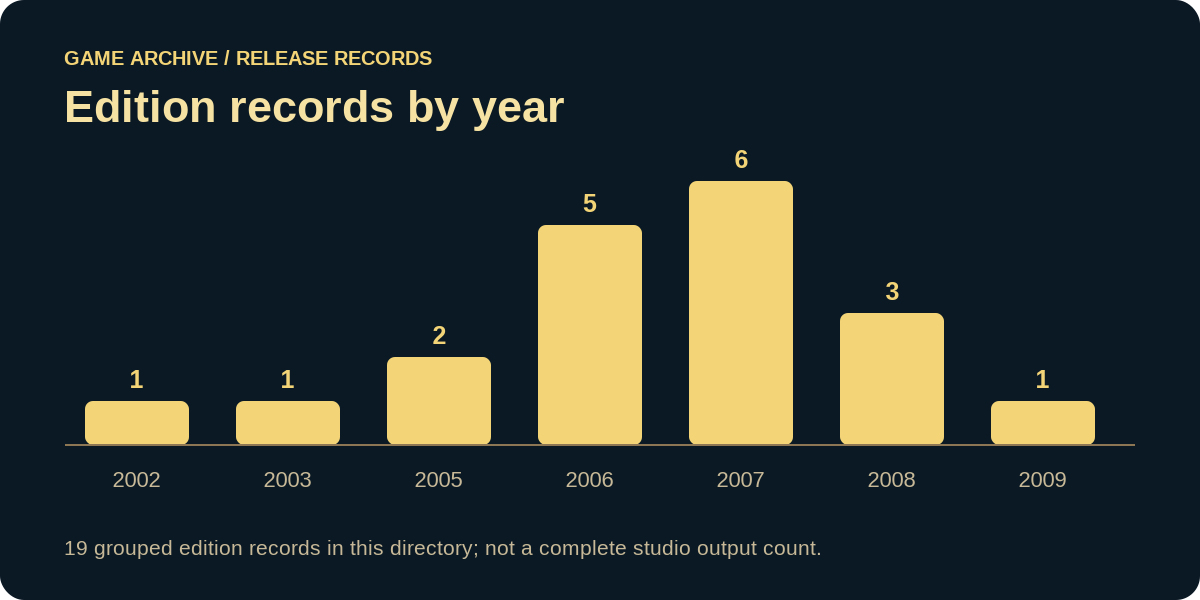
The table contains 19 edition records, not 19 unique games. It separates the two Bratz Forever Diamondz implementations and groups related platforms where the evidence supports the same broad role. The Windows edition of The Naked Brothers Band appears in the company-level index, but its exact credit is not independently established in this review; it remains a research lead rather than an additional confirmed platform in the table.
N-Gage, GBA and Other Handheld Releases
The Nokia N-Gage projects are a useful starting point for anyone interested in the studio's approach to adaptation. The first X-Men Legends and its sequel both have records for the original N-Gage platform in 2005. The first game's database description identifies a different graphical presentation from the Raven Software release, illustrating why the handheld edition deserves its own entry rather than being treated as an interchangeable copy [6]. The sequel's release record also assigns its N-Gage development to Barking Lizards [7]. Neither record establishes that BLT developed the corresponding home console games.
Game Boy Advance work formed another visible part of the portfolio. The 2006 Marvel Ultimate Alliance release is especially well documented: its platform-specific credits name Barking Lizards personnel in production, programming and art, and the release record identifies the company as developer [10]. The GBA catalogue also includes several Bratz projects and Zoey 101. These titles are useful examples of the variety of licensed entertainment properties that appeared on the same portable hardware.
Nintendo DS entries add a further dimension. The two screens and touch input offered different design possibilities from the GBA's single display and physical controls. Bratz Forever Diamondz therefore appears twice in the directory, reflecting distinct platform records rather than counting two different franchises. Zoey 101: Field Trip Fiasco is also a separate title from the GBA game Zoey 101, not merely a different spelling of the earlier release.
Super Collapse! 3 illustrates a less obvious problem with catalogue dates. Its broader game record begins in 2006, but the Nintendo DS credit page is dated 2007 [14]. Using the earlier year for the BLT handheld contribution would mix the chronology of the original product with that of a later edition.
The portfolio extends beyond Nintendo hardware. Contemporary coverage identifies Barking Lizards as the developer of Snakes Subsonic for the later N-Gage service in 2008 [3]. That service should not be confused with the original N-Gage hardware used by the X-Men adaptations. The PSP edition of SpongeBob's Truth or Square has its own development credit in 2009 [16], and is another example of why the platform field is essential.
Development, Porting and Compilation Credits
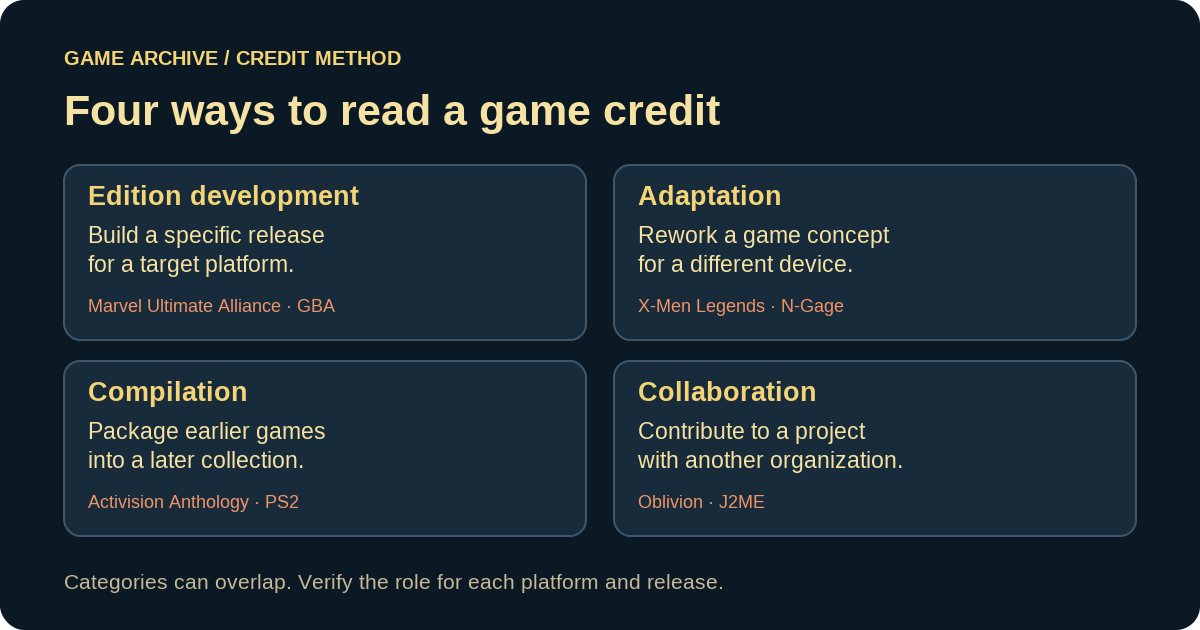
Game credits describe participation, not necessarily ownership of an entire product. A studio might implement a new game for a particular device, adapt an existing design, integrate older software into a collection or contribute to a project led by another company. These categories can overlap. A handheld adaptation may involve substantial original programming even when its characters, story and overall design originate elsewhere.
The Activision Anthology projects show why compilation work deserves separate treatment. The 2002 PlayStation 2 release includes a Barking Lizards team credit [4], while the 2003 Remix Edition explicitly identifies the studio as developer of the computer compilation [5]. Neither credit makes the company the original creator of the classic games included in those collections. The relevant contribution is to the later compilation product.
In contrast, the J2ME edition of The Elder Scrolls IV: Oblivion is a mobile adaptation. The release record lists BLT alongside Vir2L, while the transcribed credits identify Vir2L as lead developer and publisher and name Barking Lizards among its collaborators [8]. This directory uses collaboration language to preserve that distinction. It does not attribute Bethesda's desktop and console role-playing game to the Texas studio.
The Naked Brothers Band provides a similar lesson about shared production. The PlayStation 2 and Wii credit records describe participation alongside another organization [15]. Rather than interpreting a broad database developer category as proof of sole responsibility, the directory preserves the narrower relationship that the available credits support.
A port usually implies some degree of transfer from an existing implementation. Adaptation is a broader term and can include substantial redesign for a target platform. For that reason, this archive avoids calling every licensed handheld game a direct port. Read our guide to handheld game porting challenges for the technical distinction between transferring code and rebuilding a game around a different device.
How Roles Were Verified
The archive treats the title, platform, release year and company role as separate fields. A match on the title alone is insufficient. Individual credit transcriptions and release records take precedence over a company overview when the two differ in specificity. A developer listing from a secondary catalogue is useful evidence, but it is not the same as inspecting the original cartridge, disc, manual or end credits.
The verification process starts with the company index, then checks available game-specific records. For shared projects, wording is chosen to reflect the actual attribution rather than assuming that all contributors performed the same tasks. Contemporary coverage can supplement a database when a release is absent from its company list, as with Snakes Subsonic. For entries supported only by secondary catalogues, the directory explicitly labels the role as a listing.
This approach also prevents the studio's historical technology claims from being attached automatically to particular releases. The company's original site describes a cross-platform engine and toolchain [17], but that statement alone does not identify the engine used by every game in the directory. Our Whiptail game engine overview addresses the available evidence about the technology separately.
Games Needing Further Verification
Several projects require a more precise account before they can be added to the main directory or assigned additional platform credits.
Command & Conquer: The First Decade (2006, Windows). Secondary catalogues associate Barking Lizards with the collection [18]. Its exact contribution, including any integration or compatibility work, still requires a contemporaneous credit record. It should not be described as development of the original Command & Conquer games.
Cthulhu World Combat. A secondary studio history describes this mobile project as cancelled [18]. The planned release date, supported platforms and final production status require archival confirmation. It is not counted as a shipped game.
The Naked Brothers Band on Windows. The company index includes Windows, but the specific records reviewed here establish the PlayStation 2 and Wii collaboration more directly. A Windows credit roll or equivalent documentation would help determine whether the same attribution applies.
Other platform editions. A title's presence on Wii, Xbox 360, PSP or another system is not itself a BLT credit. In particular, the PSP evidence for SpongeBob's Truth or Square must not be extended to the Wii or Xbox 360 releases without separate documentation.
A missing record should not be mistaken for proof that the studio had no involvement. Older mobile titles, regional releases and work performed under contract can be poorly documented. Future additions should therefore include the exact edition and supporting evidence, rather than simply increasing a headline game count.
Individual Game Profiles
The directory is intended as an entry point for closer research rather than a substitute for individual game histories. Two case studies offer especially useful starting points:
- X-Men Legends on N-Gage: the 2005 adaptation, its platform-specific presentation and relationship to the wider franchise.
- Marvel Ultimate Alliance on Game Boy Advance: the 2006 handheld release, its documented development team and its distinction from the home console editions.
Readers interested in the people behind the work can also explore the Barking Lizards team archive. For the business context of licensed releases, see video game IP licensing.
Together, the surviving records reveal a studio whose output crossed several hardware generations and business models. The clearest way to preserve that history is to credit each contribution at the level the evidence supports: the specific game, the specific edition and the role that can actually be documented.
Sources and further reading (reviewed November 25, 2026)
- MobyGames — company game directory.
- NostalgiaBit — platform-specific console catalogue.
- All About Symbian — Snakes Subsonic, contemporary coverage.
- MobyGames — Activision Anthology PS2 credits.
- MobyGames — Remix Edition release overview and Windows credits.
- MobyGames — X-Men Legends, N-Gage.
- MobyGames — X-Men Legends II, N-Gage releases.
- MobyGames — Oblivion J2ME credits and release record.
- MobyGames — Bratz Forever Diamondz GBA releases.
- MobyGames — Marvel Ultimate Alliance GBA credits and release record.
- MobyGames — Bratz: The Movie GBA credits.
- MobyGames — Zoey 101 GBA credits.
- MobyGames — Zoey 101: Field Trip Fiasco.
- MobyGames — Super Collapse! 3 Nintendo DS credits.
- MobyGames — The Naked Brothers Band PS2 credits and Wii credits.
- MobyGames — SpongeBob PSP credits.
- Historical studio website (historical homepage at barkinglizards.com; dated snapshot not included).
- Wikipedia — studio history, research leads only.