Marvel: Ultimate Alliance for Game Boy Advance
Marvel: Ultimate Alliance for Game Boy Advance is a distinct handheld interpretation of the 2006 superhero crossover. Developed by Barking Lizards Technologies, it takes the idea of assembling Marvel heroes and translates it into a compact, single-player action game. Its identity is best understood through the cartridge edition itself rather than through the better-known console releases bearing the same title.
For readers exploring the Barking Lizards studio archive, this game provides a useful example of how a shared franchise can produce substantially different experiences on different hardware. It also illustrates why a portable adaptation deserves to be assessed on its own mechanics and reception, rather than simply treated as a smaller copy of another game.
Release, Publisher and Developer
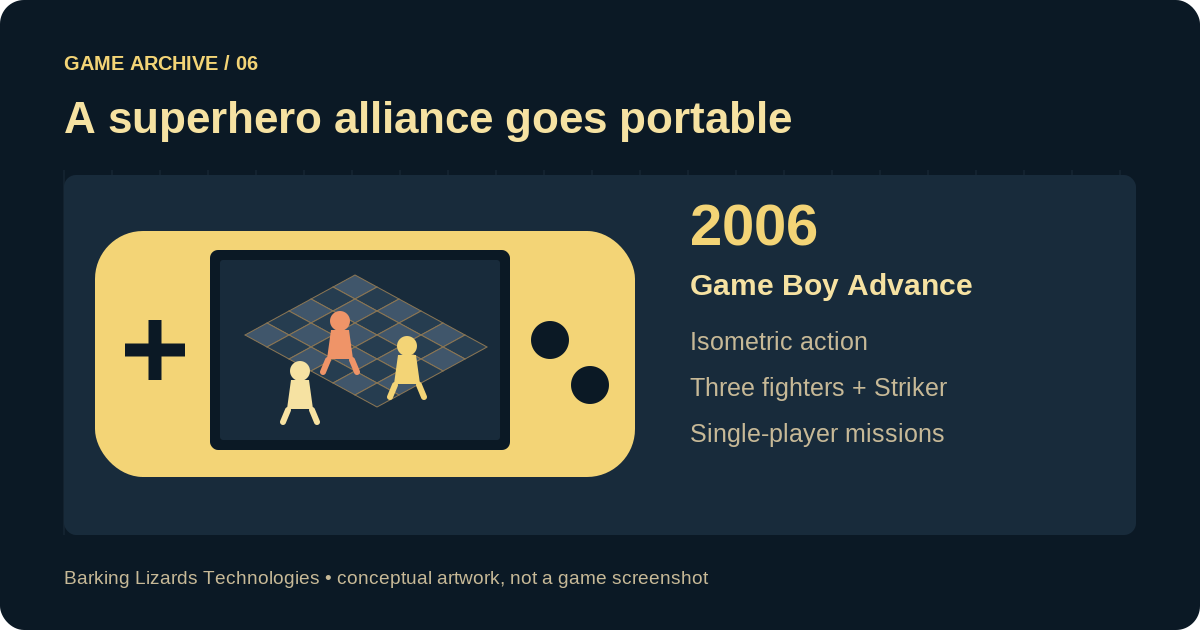
Activision published the Game Boy Advance edition in the United States on October 24, 2006, followed by the European release on November 3. GameFAQs identifies Barking Lizards as the developer and lists the American cartridge code as AGB-B4ME-USA. Its platform-specific record specifies one local player. [1]
| Edition detail | Record |
|---|---|
| Platform | Game Boy Advance |
| Developer | Barking Lizards Technologies |
| Publisher | Activision |
| North American release | October 24, 2006 |
| European release | November 3, 2006 |
| Players | One |
| US cartridge identifier | AGB-B4ME-USA |
The distinction between developer and publisher matters when researching licensed games. A publisher may coordinate a release across several platforms while assigning implementation to different teams. A common product name does not establish a common codebase, a shared set of features or identical production credits.
The GBA release is included in our games and credits directory, where individual editions are treated as separate historical records. The broader commercial relationship between a franchise and its game adaptations is discussed in our guide to video game IP licensing.
Gameplay and GBA Adaptation
The handheld game organizes its action around a selectable group of superheroes. The player can alternate between three regular fighters and call upon a separate support character, called a Striker. The original instruction booklet describes how the group is assembled before a mission and how additional characters become available during progression. [2, pp. 5–6, 12]
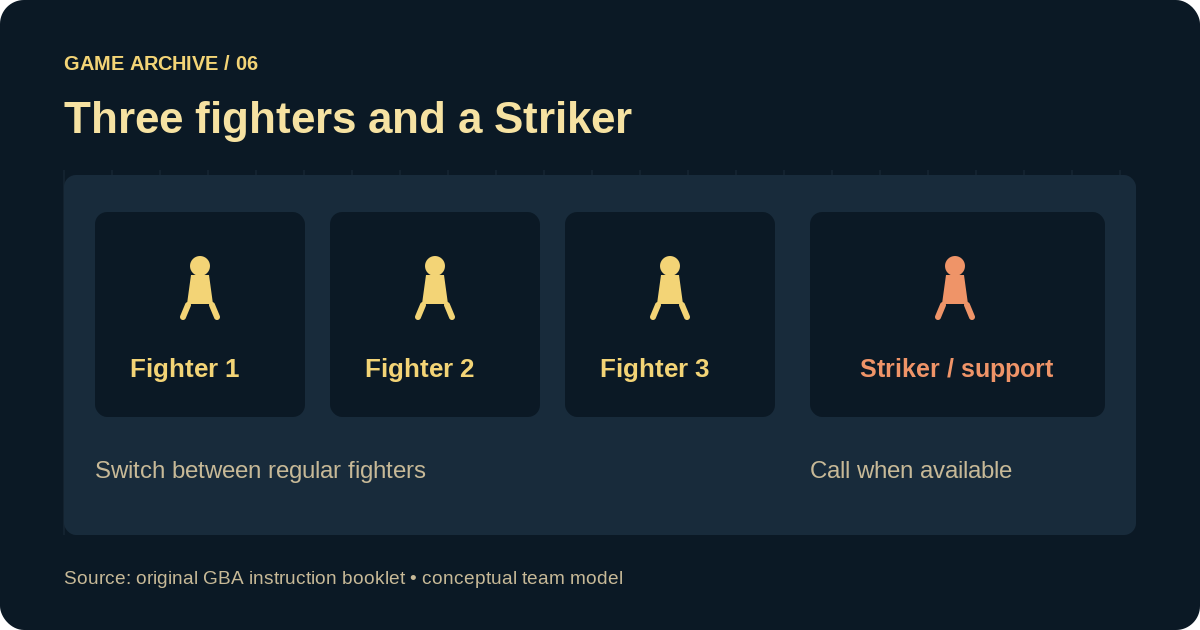
GameSpot's contemporary review describes a roster of ten playable heroes, including Spider-Man, Wolverine, Thor and Captain America. It records twelve stages and identifies Iron Man and Ghost Rider as examples of supporting Strikers rather than ordinary playable fighters. The distinction is important when comparing character lists across editions. [3]
The main activity is close-range and ranged combat in compact environments. Moving through a mission involves encounters, occasional access obstacles and confrontations with bosses. The game retains a progression component, although the emphasis is on action rather than the extensive party-management experience associated with the console title.
The instruction booklet identifies several resources that shape the action: character health, energy for special abilities, consumable items and a limited supply of support attacks. It also describes team prestige and upgrades that benefit the wider roster. Additional simulator challenges offer alternatives to the main missions. [2, pp. 8–14]
From a design perspective, shared progression can reduce the pressure to concentrate exclusively on one fighter. A player who experiments with several characters need not necessarily start the upgrade process again every time the active hero changes. The support slot introduces a second kind of roster decision: choosing a temporary contribution rather than another character to control directly. These are interpretations of the documented mechanics, not statements about the developers' private design intentions.
Differences from Console Editions
The console releases are useful as a limited point of comparison. Contemporary coverage of the larger-screen game describes a four-hero party and cooperative play, while the GBA release record specifies a single player. [1, 4] The handheld game's smaller active roster and dedicated support slot should therefore not be confused with the conventional four-character console party.
| Design element | GBA edition | Typical home-console edition |
|---|---|---|
| Presentation | Isometric action with sprite artwork | Polygonal 3D action RPG |
| Team model | Three selectable fighters plus support | Four-hero party |
| Multiplayer | Single player | Cooperative options, varying by platform |
| Hardware interface | Handheld controls and screen | Television and console controller |
The difference is more than graphical. Changing the way heroes participate in a battle changes what the player must monitor, how character selection works and what kinds of encounters the game can present clearly. A portable edition can retain a recognizable franchise premise without reproducing every system of its console counterpart.
This makes an interesting contrast with X-Men Legends on N-Gage, another Barking Lizards project with its own adaptation strategy. The two games should not be assumed to share the same technology simply because they were made by the same studio.
Visuals, Controls and Constraints
Nintendo lists the original GBA display resolution as 240 by 160 pixels. Its technical specifications also describe a 32-bit processor and dedicated handheld display hardware. [5] That small landscape display provides the basic context for evaluating the game's visual choices.
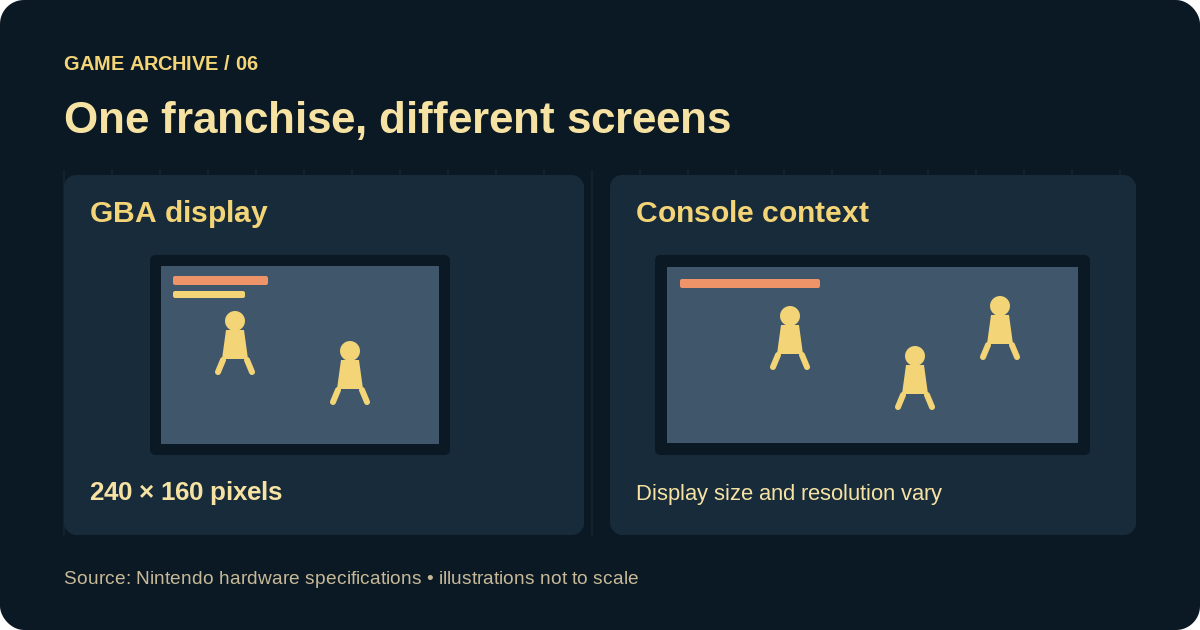
In a compact isometric scene, characters, scenery and interface indicators all compete for screen space. Distinct silhouettes can help the player identify the active fighter, while readable status indicators communicate when a change of character or a special ability might be useful. The same principles apply to the visual separation of enemies from the background.
The game's documented control scheme illustrates another adaptation problem. Its two face buttons cover jumping and ordinary attacks, while combinations and shoulder inputs extend the available actions to special abilities, character selection and support calls. [2, pp. 6–7] This approach makes several functions accessible without adding physical buttons, but also creates a need for clear feedback and consistent interpretation of simultaneous inputs.
A hardware specification alone cannot explain whether combat feels responsive. Input handling, collision feedback, animation timing and encounter design all contribute to that experience. A developer working on a similar handheld project would need to balance readable action against the amount of detail that fits on screen. These are general engineering considerations, not recovered details of the original implementation.
Our handheld game porting guide explores these trade-offs in more detail. Although the studio developed proprietary technology, the sources examined for this article do not establish the internal renderer, memory allocation, actual frame rate or exact engine version used by this cartridge. The Whiptail engine archive distinguishes surviving documentation from retrospective claims.
Contemporary Coverage and Game Credits
Frank Provo's GameSpot review, published November 2, 2006, awarded the GBA game 2.5 out of 10. It criticized repetitive combat, inconsistent hit detection, unresponsive controls and uneven animation. The reviewer regarded the superhero selection as a comparatively positive element. [3] This is one documented critical assessment, not a measurement of the game's technical performance or a summary of every player's opinion.
A historical archive should preserve that distinction. The existence of different fighter moves and progression systems in the manual does not demonstrate that those systems were satisfying in practice. Conversely, a negative review does not establish which engineering or production decisions caused the reported problems. Without development records or measured tests, attributing the reception to budget, deadlines or specific hardware bottlenecks would be speculative.
Selected Barking Lizards credits from the original booklet and indexed credit records include the following:
| Contributor | Credited responsibility |
|---|---|
| Angela Gillespie | Producer |
| Bryan Pritchard | Creative Director |
| Randy Hammonds | Lead Designer |
| David Perez | Lead Programmer |
| Steve Accomando | Level art |
| Lori Magnuson | Character art |
| Tessa Stone | Interface and effects art |
The booklet also acknowledges Raven Software and Activision. These acknowledgments should not be interpreted as proof that all three organizations performed the same development role. See our studio team archive for further context. [2, p. 15; 6]
Ultimately, the GBA edition is historically interesting because it documents a substantially different interpretation of a major licensed release. Its team system and compact presentation illustrate the scope of handheld adaptation, while its critical reception demonstrates that preserving a recognizable franchise is not the same as delivering polished gameplay. Both aspects belong in an accurate account of Barking Lizards' work.
Sources
- GameFAQs — GBA release information.
- Original US instruction booklet, digital scan, printed pp. 5–15.
- GameSpot — Frank Provo, GBA review, November 2, 2006.
- GameSpot — Ryan Davis, console review, October 30, 2006.
- Nintendo — Game Boy Advance hardware specifications.
- MobyGames — GBA credits, indexed record.
Editorial note: This independent historical article is not affiliated with Marvel, Activision or the former studio. The cartridge was not independently tested. The manual's extracted text was available, but page screenshots could not be retrieved due to file size; its column layout was therefore not independently verified. MobyGames was consulted through indexed records. Illustrations are original conceptual diagrams, not screenshots.