X-Men Legends on N-Gage
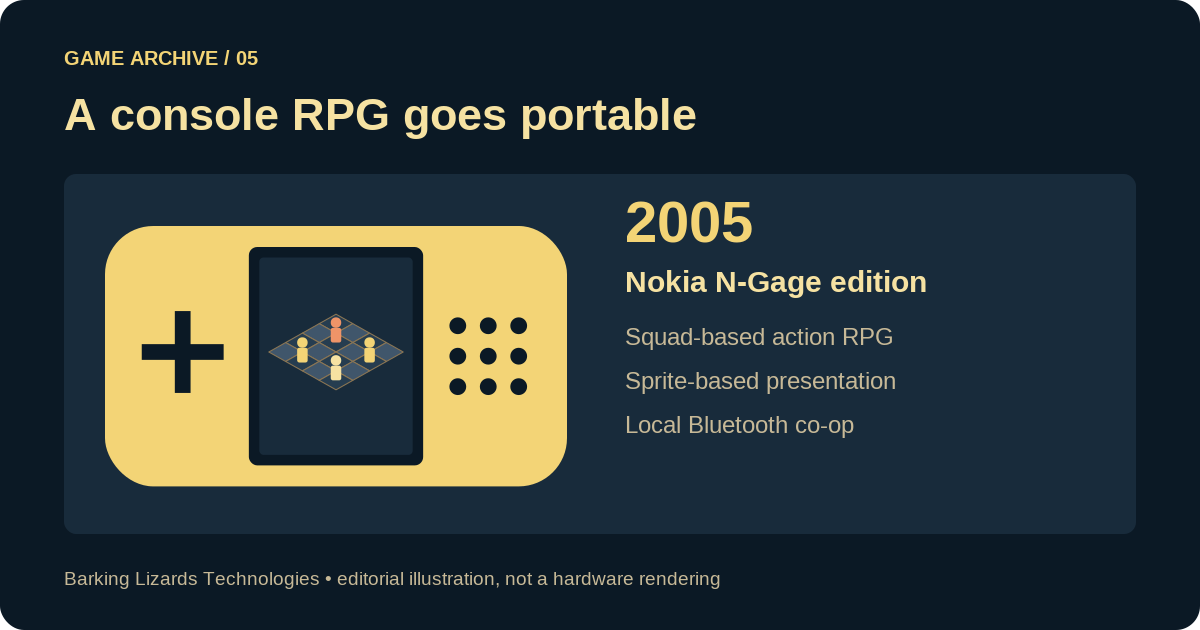
X-Men Legends on N-Gage is an example of how a licensed console game could become a substantial portable adventure without retaining the same graphics technology. Released in early 2005, the Nokia edition was adapted by Barking Lizards Technologies. Its distinguishing feature was not simply that it brought Marvel characters to a phone, but that it preserved the idea of a configurable superhero squad on a device with a small screen and physical keypad.
For retro gaming enthusiasts, this edition offers a window into the period before touchscreen smartphones. For developers, it provides a case study in deciding which aspects of a game must survive a platform transition and which can be redesigned. This profile focuses on the original N-Gage release, not its sequel or the home console editions.
Release and Developer Credits
The original X-Men Legends arrived on home consoles in 2004. The portable adaptation followed in early 2005. A September 17, 2004 hands-on report by Stephen Palley explicitly identifies Barking Lizards as the studio developing the N-Gage edition [1]. This is useful contemporary evidence rather than an attribution reconstructed solely from a modern game database.
| Edition detail | Historical record |
|---|---|
| Platform | Original Nokia N-Gage |
| Developer | Barking Lizards Technologies |
| Publisher | Activision, as listed by All About Symbian |
| Release | Early 2005 |
| Release announcement | February 7, 2005 |
| Genre | Squad-based action role-playing game |
| Multiplayer | Local Bluetooth cooperative play |
All About Symbian lists the European release in January and the North American release in February [2]. GameSpot reported Nokia's release announcement on February 7 [3]. These records should not be collapsed into a single worldwide street date. The archive identifies Activision as publisher; Nokia's role in publicizing the launch should not be confused with the development credit.
The console project was associated with Raven Software, whereas Barking Lizards was responsible for the N-Gage adaptation [4]. For further platform-specific credits, see the Barking Lizards games directory and the historical studio profile. The team archive provides context about the developers without assigning individual staff to this particular title on the basis of unrelated game credits.
How the N-Gage Version Differed
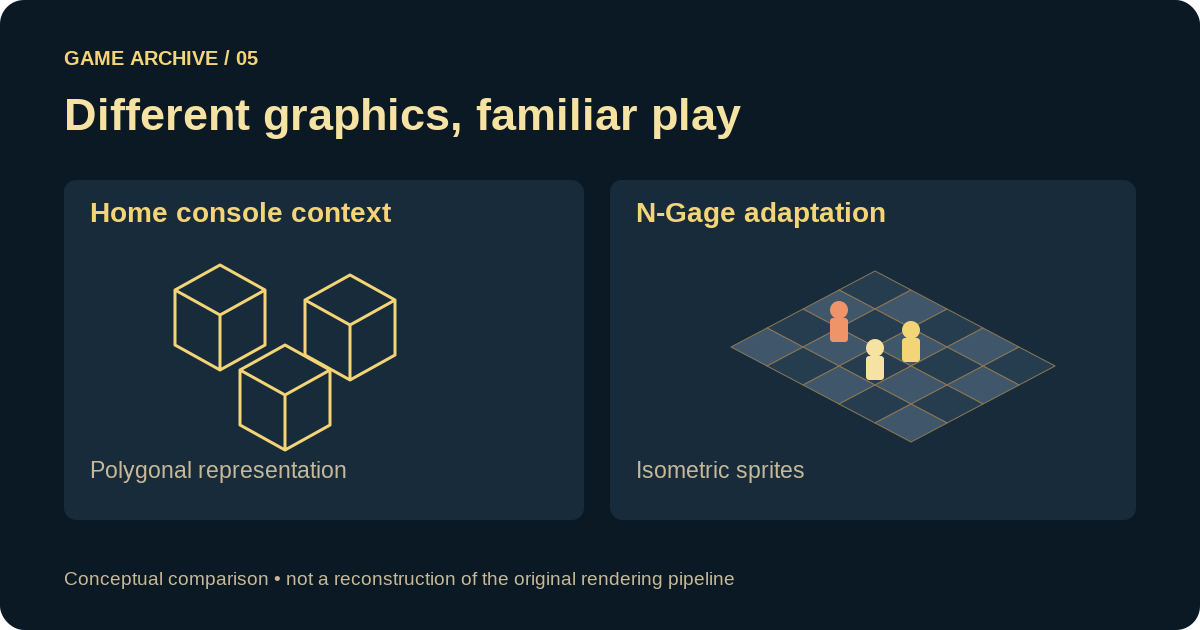
A useful way to understand the port is to separate the rules of the game from their visual representation. A party-based RPG needs to communicate character positions, abilities, objectives and progression. None of those concepts necessarily requires the same rendering method on every device. A console model and a two-dimensional sprite can represent the same fictional character while imposing very different demands on the platform.
The N-Gage edition illustrates this distinction. Its graphics were adapted to a sprite-based isometric presentation rather than reproducing the fully polygonal console visuals [4, 5]. This is a meaningful change in implementation, not a change of genre. The player still explores environments with a team and makes decisions about which powers and characters are useful.
Visuals, Controls and Perspective
The N-Gage QD had a portrait-oriented 176 by 208 pixel display [6, 7]. Even when a portable device is held horizontally, such a screen provides a very different composition area from a television. An interface designed for a wide display cannot simply be scaled down indefinitely: text becomes difficult to read, character indicators compete for space, and visual effects can obscure important information.
A fixed angled view can help a designer maintain a consistent relationship between characters and scenery. Sprite artwork also offers opportunities to control silhouette and animation readability at a known display size. These are general engineering advantages, not proof of the exact asset conversion process used by Barking Lizards. Historical accounts differ in their descriptions of the sprite production technique, so this article does not claim that all assets were drawn by hand or generated from console models.
Input was another important consideration. The early build described by GameSpot used directional selection within compact menus [1]. Such a design is well suited to physical controls because a small number of available actions can be reached without a mouse or touch interface. In a real-time RPG, the cost of opening a menu is not just the number of button presses: it is also the attention diverted away from the action.
The design challenge can be described as a balance between accessible immediate commands and less frequent management operations. Selecting a character during exploration is a different task from adjusting that character's equipment between encounters. Grouping commands by purpose is one way to preserve depth without requiring every function to occupy permanent screen space.
There are limits to what can be reconstructed from the available evidence. No source code, performance capture or asset budget was examined for this profile. A sprite-based presentation does not establish a specific frame rate, memory footprint or rendering API. The studio's Whiptail game engine is part of its technology history, but its use in this particular edition has not been verified here. For a broader engineering discussion, see handheld game porting challenges.
Bluetooth Multiplayer and Gameplay
The story introduces Alison Crestmere, also known as Magma, into the X-Men's world. Players assemble a team, advance through encounters and develop their heroes over time. Pocket Gamer's June 2005 review describes character switching, puzzles, ability improvements and combined powers [8]. This mixture gives the portable edition a role-playing identity beyond its immediate action sequences.
Different characters create different choices. A player may prefer a hero whose abilities suit a particular obstacle or whose strengths complement the rest of the party. Progression adds a longer-term dimension: the team available at the beginning of an adventure need not have the same capabilities later. Replaying sections with different characters can therefore change the experience even when the setting remains familiar.
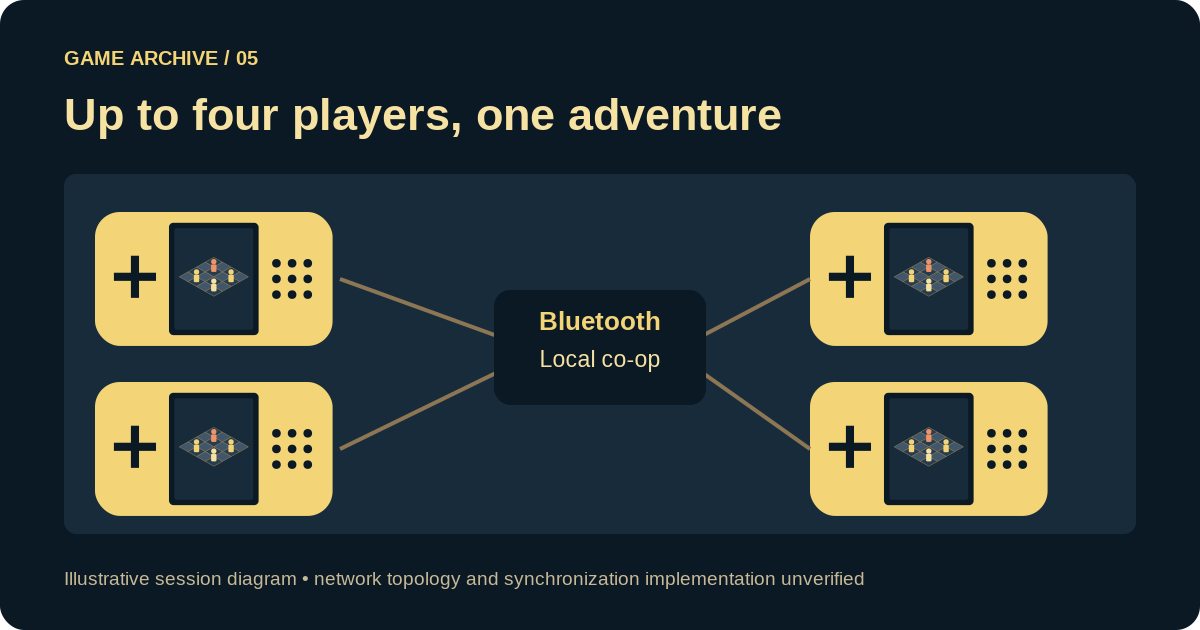
The local wireless mode allowed a group of up to four people to cooperate using Bluetooth [2, 3, 8]. This feature was particularly relevant to Nokia's attempt to combine mobile communication with dedicated gaming. Instead of merely transferring a score or exchanging an item, players could participate in the same adventure.
A single-player session and a cooperative session place different demands on the game. In the former, computer-controlled companions must remain useful without constant intervention. In the latter, people can coordinate character choices and respond to one another directly. Both modes benefit from readable feedback, but multiplayer also requires a consistent shared view of events.
From an engineering perspective, a wireless cooperative game must address the relationship between local input and shared game state. Designers must consider how players join, what happens when communication is interrupted, and how different devices interpret the same events. These are general networking questions, not documented findings about this game's protocol. No packet format, synchronization model or host architecture is asserted here.
Reviews and Historical Sources
Avery Score's GameSpot review, published February 7, 2005, awarded the N-Gage version 8.1 out of 10 [5]. It welcomed the substantial campaign, presentation and wireless cooperation, while identifying shortcomings in party-status visibility and automated healing. The review also describes spoken dialogue and video sequences, evidence that the portable presentation retained more than static text and basic animation.
Pocket Gamer's June 10 review was also favorable [8], particularly regarding the variety of gameplay and the value of playing again with different heroes. It found the combined-power controls less straightforward than other parts of the experience. These judgments matter because both reviewers assessed the game within the contemporary N-Gage market rather than against modern phones.
Later, Defunct Games revisited the release and highlighted its sprite graphics and multiplayer [9]. This retrospective is useful as a separate perspective, but the launch-era reviews remain the strongest evidence for reception at the time.
Differences from Console Versions
| Design dimension | Home console context | N-Gage edition |
|---|---|---|
| Presentation | Polygonal graphics | Sprite-based isometric presentation |
| Interface context | Television and controller | Compact portrait display and physical controls |
| Team identity | Action RPG party | Action RPG party retained |
| Cooperative play | Console multiplayer | Local Bluetooth cooperation |
The table compares broad design characteristics, not every feature of each console edition. The portable game should not be evaluated simply by counting the assets or characters it shares with the original. Its historical significance lies in adapting a substantial licensed RPG to a different interaction model while preserving the central appeal of squad play.
For another example of the studio's handheld work, see Marvel: Ultimate Alliance on Game Boy Advance. The video game IP licensing overview examines a related production context without assuming access to the contracts behind these releases.
Historical sources
- Stephen Palley, GameSpot, September 17, 2004, X-Men Legends Hands-On. Contemporary preview; developer attribution and early interface observations.
- All About Symbian, X-Men Legends — N-Gage Classic Games. Edition metadata and preserved Nokia description; its modern summary contains a conflicting cellular multiplayer claim, which is not used here.
- Tim Surette, GameSpot, February 7, 2005, X-Men: Legends mutates onto N-Gage. Release reporting and Bluetooth confirmation.
- MobyGames, X-Men: Legends (2005). Indexed edition description; direct page returned HTTP 403 during research.
- Avery Score, GameSpot, February 7, 2005, X-Men Legends Review. N-Gage-specific review and score.
- Phone Scoop, Nokia Announces N-Gage QD. Hardware display specification.
- All About Symbian, Nokia N-Gage QD. Hardware context.
- Pocket Gamer, June 10, 2005, X-Men Legends Review. Contemporary gameplay and reception.
- Defunct Games, X-Men Legends Review for N-Gage. Retrospective review.
This independent historical profile is based on published records, not hands-on testing of an original cartridge. Illustrations are original editorial diagrams, not screenshots or recovered technical documentation.