Slot Game Certification Process
The slot game certification process examines whether a defined gambling product meets applicable technical requirements. A real-money game can have financial consequences for customers, so evaluating its animations and checking that it loads correctly are not enough. Independent evidence about randomness, mathematical behavior and software integrity may be necessary before the product can be offered legally.
Certification is not a promise that a player will win, an endorsement of a game's entertainment value or a universal permission to operate. It is an assessment with a specified scope. This article explains the distinction using Great Britain's Gambling Commission (UKGC) and the technical standards published by Gaming Laboratories International (GLI). The historical Barking Lizards games archive covers conventional video games; the regulated products discussed here are a separate subject.
Who Requires Certification and Why
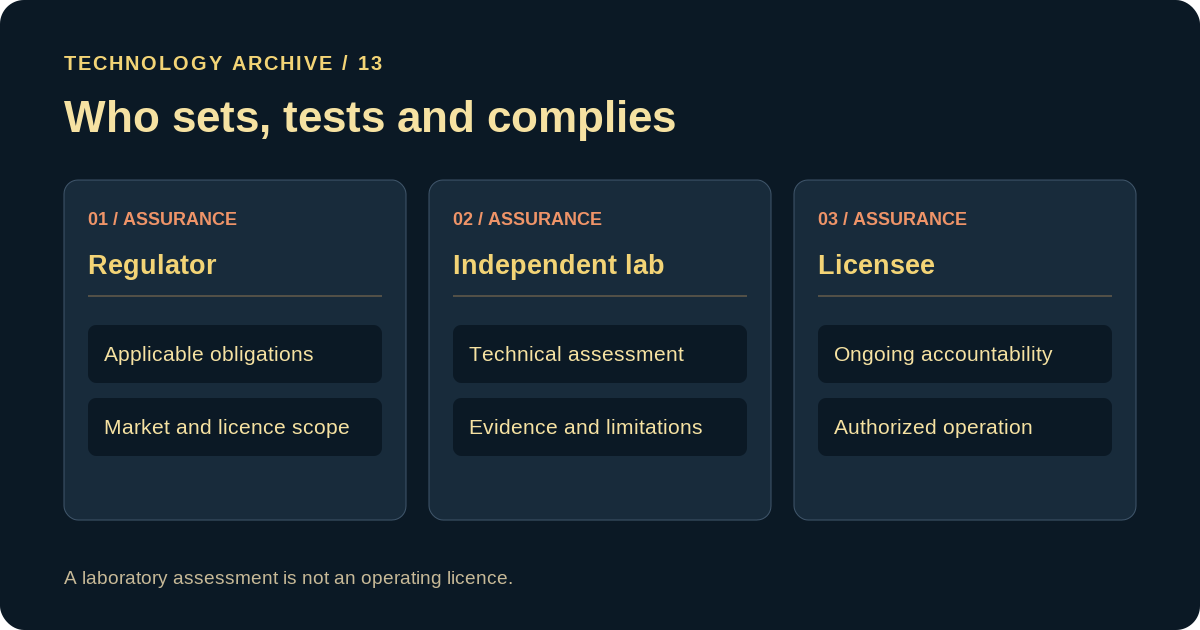
A gambling regulator establishes obligations for activities within its jurisdiction. The relevant licence, product category and technical rules determine which evaluations are required. An independent laboratory assesses the product against the applicable criteria and provides evidence of its findings. The responsible licensee must ensure that the product actually offered to customers remains within the permitted scope.
These responsibilities should not be confused. A supplier may commission laboratory work, while a licensed operator may have separate obligations concerning the games it makes available. A favourable laboratory result cannot remove the operator's responsibility for its activities. Nor does a report necessarily imply that a regulator has individually approved every aspect of the product.
The purpose of technical evaluation is to reduce the risk of unfair or misleading behavior. A discrepancy between published rules and software behavior can cause harm even when it results from an ordinary programming error rather than intentional misconduct. Independent scrutiny provides a different perspective from the team that designed the game.
Jurisdiction-Specific Requirements
In Great Britain, the UKGC Remote Gambling and Software Technical Standards (RTS) apply to relevant licence holders. The accompanying testing strategy establishes the applicable assurance arrangements. Where external testing is mandated, the Commission requires the use of a laboratory on its approved test house list.
GLI has a different role. It publishes technical benchmarks and provides independent assessment services. Its standards catalogue explains that jurisdictions determine their own requirements. The current published GLI-19 edition at the time of this article's review is version 4.0, revised November 3, 2026; version 3.0 remains in the standards archive. Publication does not establish the date on which any particular market adopts the revision.
| Item | Role in assurance |
|---|---|
| UKGC RTS | Technical obligations for applicable British licences |
| UKGC testing strategy | Determines relevant testing and reporting arrangements |
| GLI-19 | Technical benchmark for interactive gaming systems |
| Laboratory report | Evidence concerning an identified submission and scope |
| Operating licence | Separate legal permission subject to its own conditions |
A useful interpretation of any certification statement therefore begins with the market, the applicable edition of the standard and the identity of the assessed software. A general claim of international certification does not answer these questions. Requirements from one jurisdiction should not be applied automatically to another.
RNG and Mathematical Model Testing
Random number generation and game mathematics are related but distinct. An RNG supplies values used by the game. The mathematical model describes how outcomes are associated with probabilities and awards. A sound random source does not guarantee that the rest of the software interprets its output correctly.
For readers unfamiliar with the terminology, our comparison of video game RNG and slot RNG explains pseudorandomness, expected value and the differences between entertainment games and regulated products.
The British RTS 7 requirements address acceptable randomness and the integrity of outcome generation. A relevant assessment considers statistical behavior and unpredictability, among other properties. Passing a statistical test is not mathematical proof that a sequence will remain unpredictable under every circumstance. Conversely, a short run of similar outcomes does not by itself demonstrate a defective generator.
The Commission's testing approach distinguishes random-source assessment from evaluating the game itself. The latter considers the mathematical specification, implementation and observed behavior. This distinction matters because errors can occur in the interpretation of random values even when the underlying generator has already been examined.
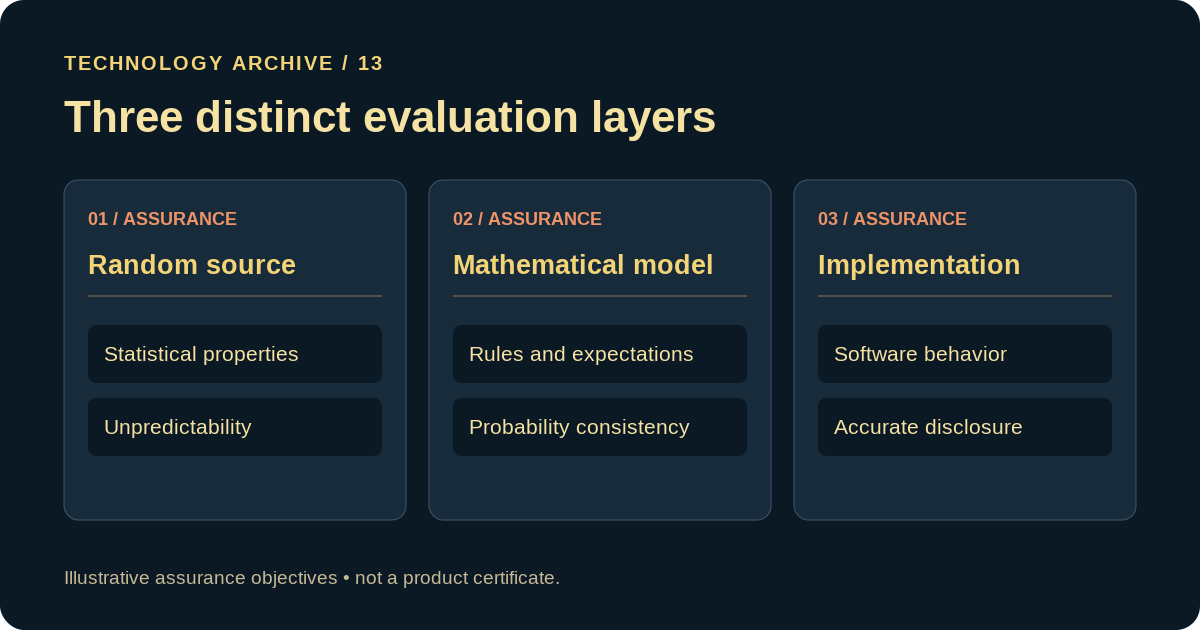
Mathematical documentation gives reviewers a reference against which to assess game behavior. It should make the intended rules and expected properties understandable. Return to player (RTP) represents expected gross returns relative to stakes over the specified model, while volatility describes variation in returns. Neither describes the outcome a particular person should expect in a short session. The RTS 3 disclosure rules address information that customers need to understand the game.
| Review area | Central question |
|---|---|
| Random source | Are its relevant properties supported by evidence? |
| Mathematical specification | Do the stated probabilities and expected returns agree with the rules? |
| Implementation | Does the software behave consistently with the documented model? |
| Customer information | Does the displayed description accurately represent the product? |
These categories describe assurance objectives rather than a recipe for constructing a wagering system. They are also not interchangeable: a successful RNG evaluation alone cannot establish that every game using it is fair. Statistical estimates of observed return must be interpreted in light of sample size and variability, not treated as exact predictions.
Software QA vs Independent Certification
Internal quality assurance is the development team's continuing process of finding defects, checking requirements and recording test results. In a browser-based product, this can involve device compatibility, interface behavior, accessibility, error handling and consistency between displayed information and recorded events. The HTML5 slot game development process describes how such activities fit into the broader production lifecycle.
Independent evaluation has a different purpose. The reviewer assesses evidence against defined external criteria and must be able to identify the submission under examination. Independence matters because a team familiar with its own design may unconsciously assume that the intended behavior is already correct. The outside reviewer can challenge that assumption.
GLI-19 v4.0, section 1.5.1, describes laboratory evaluation under conditions representative of production where relevant, including access to implementation evidence. Section 2.3 addresses integrity checks for critical control software. These provisions illustrate why the identity and configuration of the evaluated system matter, rather than just its public-facing title. See the published standard.
Internal QA and independent assessment complement each other. A laboratory evaluation does not replace routine regression testing, and a large internal test suite does not automatically satisfy an obligation for external review. Likewise, an assessment of a component may leave questions about its behavior when integrated into a larger platform.
Typical Evidence and Reports
Documentation makes the relationship between the intended product, the assessed submission and the released version understandable to reviewers. It also provides historical evidence if a discrepancy is discovered after launch. The following categories are illustrative, not a universal submission checklist.
| Evidence category | What it helps establish |
|---|---|
| Product and rules specification | Intended behavior and customer disclosures |
| Mathematical documentation | Basis for expected game properties |
| Version and configuration records | Identity of the assessed product |
| Internal QA records | Evidence of functional and regression checks |
| Independent report | Findings, scope and applicable limitations |
| Change history | Differences between successive releases |
The UKGC procedure for testing describes information expected in game and RNG reports, including identification of the assessed version, the laboratory and relevant limitations. It requires satisfactory testing and submission of the relevant reports before new games and RNGs are released under the applicable arrangements. This is a specific British obligation, not a global filing procedure.
A certificate reference is useful only if it can be related to the actual product being considered. A customer-facing logo, an undated screenshot or a report for another configuration is not equivalent evidence. Even a genuine certificate may cover a narrower component than a reader assumes. Public descriptions should avoid claiming more than the underlying document supports.
Changes, Retesting and Limitations
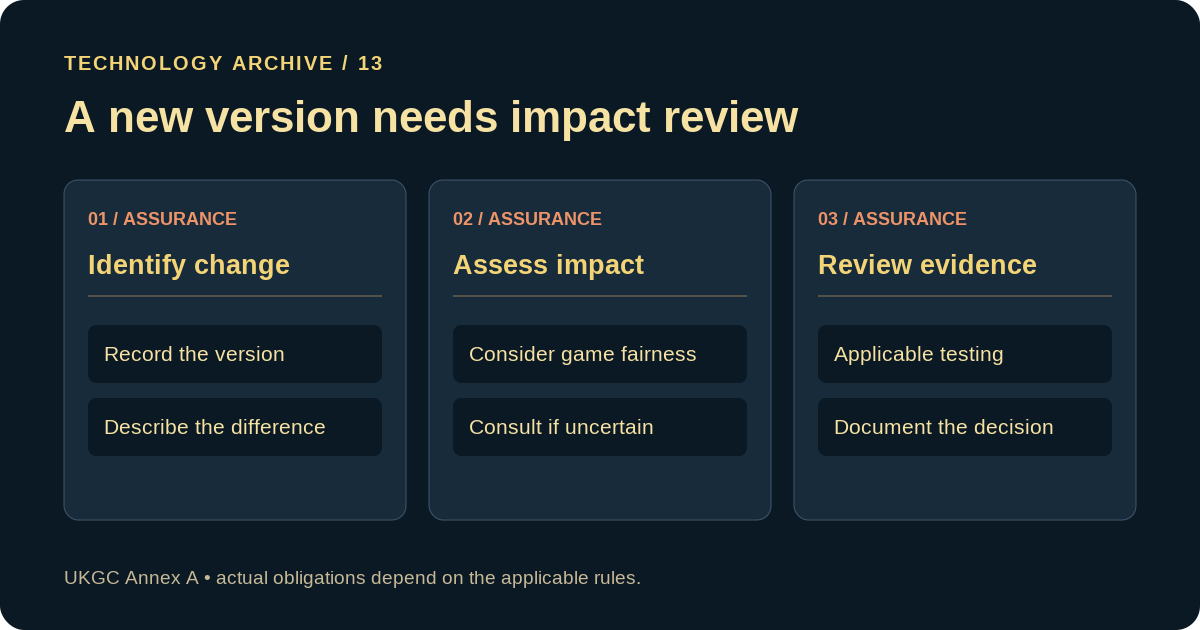
Certification is tied to a defined assessment scope, not merely a product name. Subsequent changes can alter the properties that were originally reviewed. For that reason, version control is an assurance issue as well as an engineering practice. A record of what changed, why it changed and what was evaluated helps maintain accountability.
Under the UKGC Annex A guidance, changes that could affect game fairness require external retesting. Changes without such an impact may qualify for internal handling under the applicable conditions. The distinction depends on the consequences of the modification, not the number of lines of code or the size of the download. Uncertainty about classification warrants consultation with the relevant laboratory.
The Commission also publishes in-house development and release guidance and describes annual games testing audits for specified licensees. These arrangements illustrate that independent assurance can extend beyond the initial evaluation. GLI-19 likewise recognizes that later integration and modification may require further assessment according to the relevant authority's requirements.
Post-release monitoring is a separate source of evidence. The UKGC's live RTP monitoring guidance discusses interpreting observed results in relation to designed return and variability. Monitoring cannot guarantee the absence of every defect, but it can help identify discrepancies that deserve investigation.
The same distinction between engineering work and regulatory scope applies to HTML5 slot performance. An optimization described as a visual improvement is not automatically exempt from review if it changes relevant behavior. Similarly, video game IP licensing concerns permission to use intellectual property, which remains separate from gambling compliance.
Ultimately, certification provides bounded evidence about an identified product against specified requirements. It does not eliminate financial risk to players, guarantee future software behavior or substitute for legal permission. For a particular release, the applicable regulator and qualified independent laboratory remain the authoritative sources of requirements. This article is educational and is not legal advice or an assessment of any actual gambling product.
Editorial review: November 25, 2026. Regulatory and technical references are linked throughout. No laboratory tests or product certification were performed.