How HTML5 Slot Games Are Developed
The HTML5 slot game development process combines browser engineering, documented game mathematics, visual production and regulatory assurance. Unlike a conventional entertainment game, a real-money product must account for the financial consequences of its behavior. A polished animation is therefore only one part of a much larger system: the rules, recorded outcomes, account information and release evidence must all agree.
HTML5 is an industry shorthand for a browser-based technology stack rather than a complete game engine. JavaScript or TypeScript, graphics APIs, audio services and network interfaces can support the presentation layer. The surrounding platform supplies other services, subject to its own technical and legal requirements. This guide describes a conceptual production lifecycle, not a ready-to-deploy gambling system or a development service. The historical Barking Lizards games archive concerns conventional video games; the modern regulated products discussed here are a separate industry.
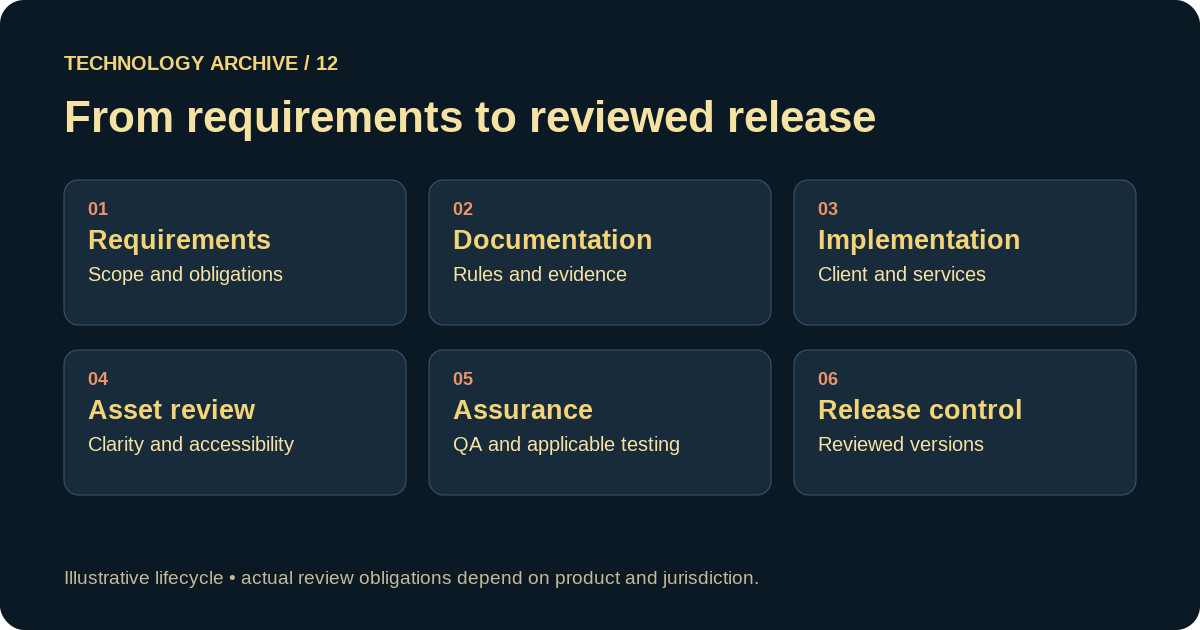
Game Concept, Mathematics and Documentation
A project begins by defining the intended product and its operating context. A requirements document identifies supported devices, languages, accessibility expectations, applicable markets and the responsibilities of participating organizations. It also records the intended presentation, the rules that must be communicated to users and the evidence required before release. If a proposed feature conflicts with a market requirement, that conflict needs to be resolved before artwork or software is finalized.
The game design document describes the experience from the user's perspective. It should distinguish ordinary display states, rules and help screens, pending operations, completed results and unavailable services. A separate mathematical specification documents the outcome model and its expected properties. The two documents serve different readers but must use consistent terminology. A designer should not describe a result that the mathematical specification does not support.
Return to player (RTP) describes expected gross returns relative to stakes over the relevant model. It is not a promise about an individual session. Volatility concerns the variability of returns, while the probability of receiving a payout is another distinct measure. These concepts belong in the mathematical documentation and any applicable customer disclosures, not in marketing claims implying predictable winnings. The comparison of video game RNG and slot RNG explains the distinction between random number generation and the rules that interpret random values.
| Document | Purpose | Review question |
|---|---|---|
| Product requirements | Scope and target environment | Which markets and devices are included? |
| Design specification | Rules and visible behavior | Does the interface describe the rules accurately? |
| Mathematical specification | Outcome model and statistical properties | Are the stated properties supported? |
| Integration specification | Boundaries between services | Who owns each category of information? |
| Compliance matrix | Applicable obligations and evidence | Has each requirement been assigned an owner? |
| Test plan | Verification and acceptance criteria | What evidence will demonstrate conformity? |
These are illustrative document categories, not a universal regulatory submission checklist. A small project may combine several documents, whereas a complex platform may maintain separate controlled records for each. The important principle is traceability: a requirement should be identifiable in design, implementation, testing and release evidence.
Brand permissions are another early dependency. A licensed theme may require approval for specific artwork, language or markets. The video game IP licensing guide explains why permission to use a property is distinct from permission to distribute a regulated gambling product.
Client and Server Responsibilities
A browser is an environment controlled in part by the user's device. Its local display state can be interrupted, modified or lost. Consequently, an architecture that treats a browser animation as proof of a financial event would be unsuitable. A common conceptual separation places presentation in the client and authoritative financial and outcome records in controlled backend services. The exact division varies by platform, license and system design; this is not a prescribed regulatory topology.
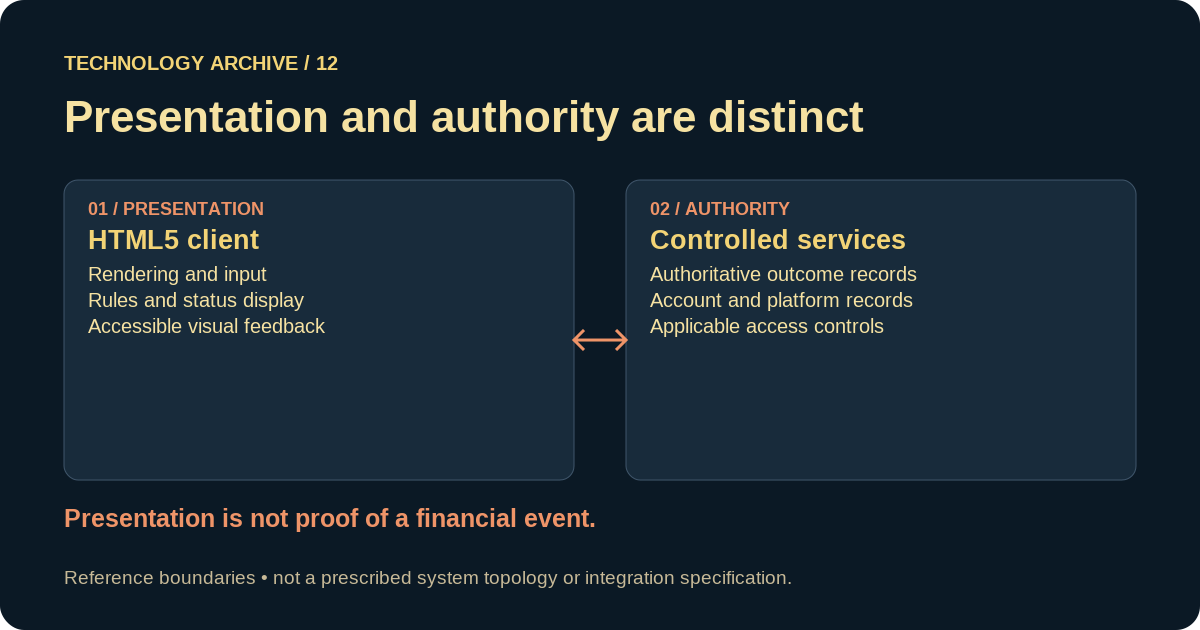
The client handles input, visual feedback, language selection, rendering and accessibility-related presentation. It communicates the status of an operation and displays the recorded result when available. Backend services are responsible for authoritative records according to the platform's defined responsibilities. An operator platform may also provide account information, access restrictions and safer gambling controls. These responsibilities require agreement between participating organizations, rather than assumptions made by a frontend team.
| Concern | Browser presentation | Controlled services or platform |
|---|---|---|
| Rules | Display approved information | Maintain the applicable version |
| Outcome | Present recorded result | Establish and retain authoritative result |
| Account information | Show confirmed information | Maintain authoritative account records |
| Interruption | Show a clear pending or unavailable state | Establish the status of the interrupted operation |
| Restrictions | Reflect applicable controls | Enforce relevant eligibility and limits |
| Version | Identify delivered client | Maintain release and evidence records |
The distinction becomes important when connectivity fails. A user may lose a connection after an action has been submitted but before the interface receives confirmation. An error message alone does not establish whether that action was completed. A coherent product needs an agreed recovery policy that avoids misleading the user about the outcome or account position. Great Britain's RTS 10 addresses interrupted gambling, while RTS 5 concerns result determination. [4][5] These obligations must be interpreted for the actual product and jurisdiction.
Frontend Rendering and Backend Integration
The browser stack can include Canvas 2D or WebGL for graphics, HTML and CSS for interface elements, and JavaScript for coordinating display state. Fetch and WebSocket are examples of network APIs available to web developers, although neither is inherently required for a particular product. MDN's overview of web game development describes these technology categories. [1] The HTML5 game engine architecture guide covers game loops, scenes and resource ownership in more detail.
The frontend should clearly distinguish an unavailable service, an operation awaiting confirmation and a confirmed result. Animation timing is a presentation concern and should not change the recorded outcome. Similarly, restarting a visual scene must not create the impression that a financial operation has been reversed or repeated. The displayed state must be consistent with the authoritative information supplied by the platform.
Integration reviews should establish the meaning of each category of status and the responsibility for communicating errors. Documentation should identify which organization maintains the rules, records and customer information, including what happens if a dependency is unavailable. Sensitive information should not be exposed merely because a browser needs to render an interface. Security assessment, privacy review and platform acceptance are separate activities that require appropriate expertise.
Visual Assets and Interaction Design
Visual production generally creates illustrations, symbol artwork, interface components, typography, animation and audio. Source files are distinct from the exported resources delivered to browsers. Designers may work with vector artwork and layered raster images, while the runtime receives appropriately formatted assets. A manifest can document which assets belong to a release. This also helps reviewers establish whether the presented interface matches the version they evaluated.
An asset review should consider readability on small screens, supported languages, contrast, text overflow and the meaning conveyed by motion or sound. Color should not be the only way to communicate a status. A localized interface may need considerably more room for a translated label than the original layout. Important rules and account information should remain understandable when audio is muted or animation is unavailable.
Browser audio introduces its own constraints. Playback may require a user interaction before the audio context becomes active; sound controls should remain usable regardless of that policy. MDN discusses these restrictions and audio design considerations. [2] In a regulated product, audio is also part of the communication of results. It should not contradict the monetary meaning of an outcome.
Great Britain's responsible product design requirements provide a concrete example of why interface decisions cannot be evaluated solely for entertainment value. RTS 14 includes restrictions on certain features and presentations in remote gambling products, with provisions specific to slots. [6] A review should therefore examine what the interface communicates, not simply whether a visual effect runs smoothly. Avoiding misleading celebrations, preserving user control and accurately presenting results are important review objectives. The applicable rules must be checked rather than inferred from another market's product.
Mobile testing also needs to account for changes in screen size, orientation, browser visibility and device capability. An interface should remain legible when the viewport changes and should recover gracefully after a backgrounded tab is restored. Asset download size, decoded memory use and display performance are distinct measurements. The dedicated HTML5 slot performance guide discusses browser performance separately; speed improvements must not be confused with shortening regulated game cycles or encouraging more frequent gambling.
Testing, Certification and Release
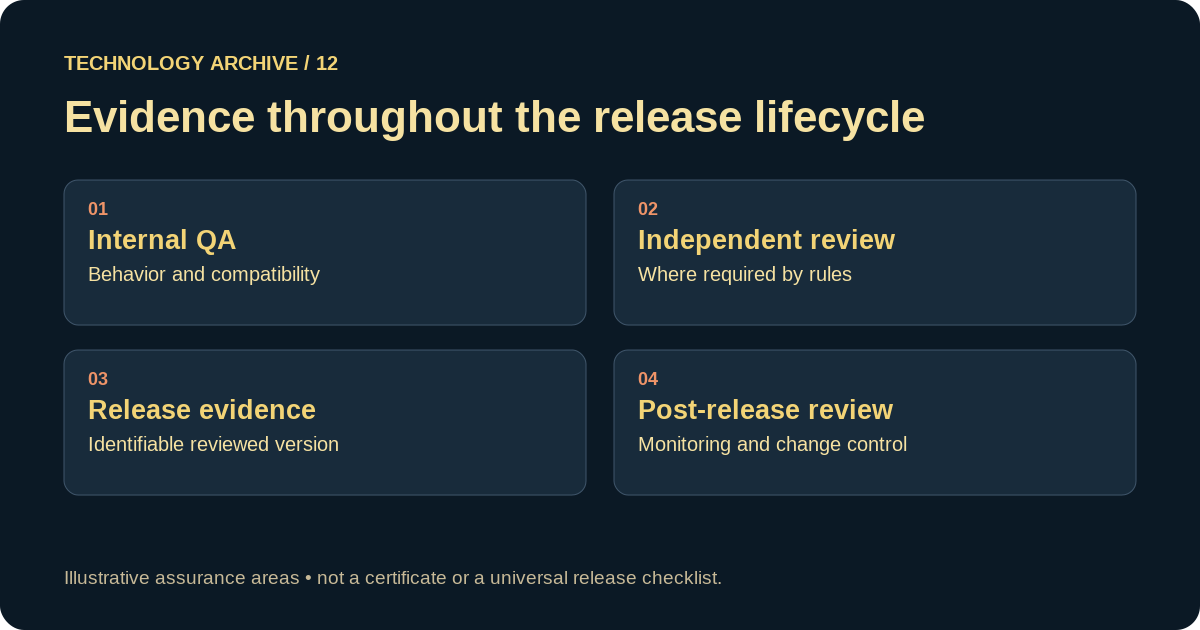
Quality assurance starts with requirements, not with a final inspection of the artwork. Test cases should link to documented rules and expected behavior. Reviews need to cover normal use, unexpected states, accessibility, platform integration and the consistency of customer-facing information. Mathematical verification and security review address different questions from ordinary browser compatibility testing.
| Assurance area | Illustrative evidence |
|---|---|
| Functional QA | Recorded checks against approved behavior |
| Mathematical review | Independent analysis where required |
| Integration QA | Evidence of consistent displayed and authoritative states |
| Interruption handling | Tests of connectivity loss and restoration |
| Responsible design | Review against applicable product design requirements |
| Compatibility | Device and browser test results |
| Security | Relevant assessment and remediation records |
| Release control | Identifiable reviewed version and approval records |
This table is an engineering-oriented overview. It does not replace the requirements of a regulator or testing laboratory. In Great Britain, the Gambling Commission publishes remote gambling and software technical standards together with a testing strategy that defines applicable timing and procedures. [3][7] Its testing approach distinguishes areas of risk and the evidence expected from licensees or approved test houses. [8] Where applicable, test reports are submitted before release under the specified procedure. [9]
Independent testing should not be described as a universal guarantee that a product is lawful everywhere. A report relates to a defined scope and version, and operating permissions are separate from the assessment of software. Responsibilities can differ across jurisdictions and license categories. Teams should establish the exact requirements with qualified compliance specialists before committing to a release schedule.
Release management connects the reviewed product to what customers actually receive. A release record identifies the relevant software and resource versions, the environment covered by the review, unresolved issues and responsible approvers. Browser caches complicate this because different users may temporarily receive resources from different releases. Service workers can manage cached assets, but their lifecycle needs careful consideration. [10] Cached presentation resources must never be mistaken for authoritative financial records or permission to continue real-money operations offline.
After release, monitoring and incident management remain necessary. A team should distinguish a rendering defect from an inconsistency in recorded outcomes or customer information. Changes to rules, mathematics, integration behavior or regulated interface features may have different review consequences from minor artwork changes. The applicable testing strategy and change-control process determine whether further assessment is necessary. The Commission also publishes guidance on in-house development and release practices. [11]
A mature process treats evidence as part of the product rather than as a document assembled at the end. The objective is a version whose behavior is understood, whose limitations are visible and whose release can be justified against the relevant requirements. Technical performance, visual quality and regulatory conformity are complementary objectives, not interchangeable measures of success.
Links to Specialist Guides
For browser technology and the transition from older mobile platforms, see J2ME vs HTML5 game development. For architecture, see the engine guide linked above. The slot game certification guide focuses on testing scope, evidence and jurisdiction-specific review. Together with the separate RNG and performance articles, these resources explain the production lifecycle without implying that the historical Barking Lizards studio developed gambling products.
This article is general technical and regulatory information, not legal advice, a certification claim or gambling advice.
Sources (checked November 25, 2026)
- MDN — Introduction to game development for the Web.
- MDN — Web Audio API best practices.
- UK Gambling Commission — Remote gambling and software technical standards.
- UKGC — RTS 10: Interrupted gambling.
- UKGC — RTS 5: Result determination.
- UKGC — RTS 14: Responsible product design.
- UKGC — Testing strategy.
- UKGC — Testing approach.
- UKGC — Procedure for testing.
- MDN — Using Service Workers.
- UKGC — In-house developing, testing and release.