RNG in Video Games vs Online Slots
Randomness gives video games variety, but its purpose changes when an outcome determines a real-money payout. A role-playing game may use random numbers to vary enemy encounters, while a regulated online slot must generate outcomes in accordance with its documented rules and applicable technical standards. Comparing video game RNG vs slot RNG therefore requires more than identifying an algorithm: it requires understanding the rules, the environment in which the algorithm operates, and the evidence that supports its behavior.
This guide explains the distinction from an engineering and consumer-information perspective. It is not gambling advice. The historical Barking Lizards games archive provides context for conventional game development; the regulated products discussed here are a separate modern industry, not documented projects of that studio.
What an RNG Does
A random number generator (RNG) supplies values that software can use when selecting events. A pseudorandom number generator (PRNG) uses an algorithm and internal state to produce a sequence. Starting from the same state under the same implementation can reproduce that sequence. A seed is an input used to initialize the state; it is not necessarily the entire state of the generator. Sources of entropy can supply unpredictable inputs to a generator. [1]
Statistical quality and unpredictability are related but different properties. A sequence can appear evenly distributed and still be predictable to someone who knows its state. Cryptographically secure generators are intended to provide stronger protection against prediction than general-purpose generators. That distinction matters when an outcome has financial consequences.
For example, the JavaScript Math.random() function is a general-purpose source of pseudorandom values, not a cryptographically secure one. The Web Crypto API offers getRandomValues() for cryptographically strong values. Neither API, considered alone, demonstrates compliance with a gambling standard: the surrounding system, outcome rules and implementation must also be evaluated. [2][3]
An RNG produces values, whereas a game interprets them. A uniform source does not mean that all visible events must occur with the same probability. Different events can have different probabilities under the game's rules. The distinction between the source of randomness and the rules that interpret its output is essential to evaluating fairness.
| Concept | Meaning |
|---|---|
| Seed | Input used to initialize a PRNG |
| State | Internal information that determines subsequent algorithm behavior |
| Distribution | Probabilities associated with possible values or events |
| Independence | One event does not change the probability of another, where the model assumes independence |
| Unpredictability | Future values cannot feasibly be inferred under the relevant assumptions |
Randomness in Ordinary Video Games
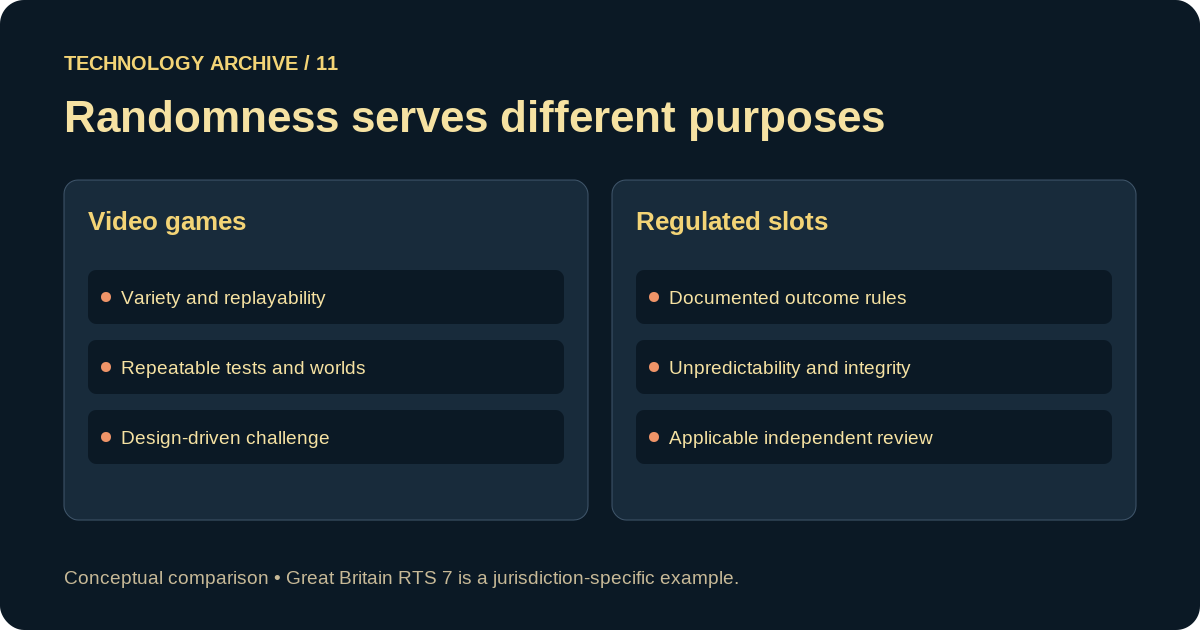
In conventional games, randomness is a tool for designing experiences. Procedural maps, cosmetic effects, enemy behavior and item selection may all use random values. The designer can choose between consistent challenges and variation, depending on what makes the experience readable and enjoyable. A puzzle generator might reproduce a particular layout so that players can share it. An adventure game might vary scenery without changing the story.
The Godot documentation illustrates how games can use separate generator instances and control their seeds and state. Such features are valuable for reproducing a defect or creating a repeatable test. Reproduction also depends on the algorithm version, the order of calls and other inputs; a seed alone is not a universal replay format. [4]
A game can deliberately adjust encounter difficulty to match a player's progress. It may also constrain random events to avoid repetitive or frustrating patterns. These decisions are part of the design, rather than proof that the underlying generator is defective. However, ordinary games can also involve paid random rewards or competitive economies, which raise separate consumer protection and security questions. The distinction in this article is about conventional gameplay versus regulated real-money slot outcomes, not a claim that all video game randomness is unregulated.
Separating random gameplay decisions from cosmetic animation helps testing. Otherwise, adding an extra visual effect may change the sequence of values consumed by gameplay and make a previously reproducible bug difficult to investigate. Our HTML5 game engine architecture guide discusses the broader separation between simulation and presentation.
| Engineering concern | Conventional gameplay | Regulated slot outcomes |
|---|---|---|
| Design objective | Variety, challenge, replayability | Outcomes consistent with documented rules |
| Repeatability | Often useful in development and shared worlds | Controlled test evidence, not predictable live outcomes |
| Difficulty adaptation | May be intentional | Compensated outcome behavior prohibited under GB RTS 7 |
| Security | Depends on game and threat model | Outcome integrity and unpredictability are central |
| Assurance | Developer QA and relevant platform rules | Applicable regulatory and independent testing obligations |
Random Outcomes in Regulated Slots
The Gambling Commission's remote gambling and software technical standards (RTS) provide a jurisdiction-specific example for Great Britain. RTS 7 addresses the generation of random outcomes. Its requirements concern the quality and unpredictability of random results and the correct relationship between generator output and game outcomes. It also prohibits compensated games that alter outcome probabilities through adaptive behavior. [5]
This changes the role of software presentation. A reel animation is a way to communicate a result; it should not be mistaken for evidence that a random number has been generated correctly. Visual polish, smooth animation and responsive controls cannot establish the fairness of the underlying outcome. The rules governing a result, the actual result recorded by the system, and the information shown to the player must agree.
A useful distinction is between randomness and the mathematical model. The former concerns the source of uncertain values. The latter defines the possible results and their probabilities and financial consequences. Testing only the generator would miss errors in how results are interpreted. Conversely, correct mathematics on paper does not show that the deployed software faithfully implements it.
Game Mathematics and Disclosure
Probability describes how likely an event is under a stated model. Expected value describes the probability-weighted average of a quantity. For a fixed stake, theoretical return to player (RTP) is the expected gross payout divided by that stake, expressed as a percentage. It includes returned stakes where those are part of the gross payout definition. RTP is not the probability of winning and is not a promise about any individual's session.
Consider a non-monetary classroom experiment: a fair six-sided die awards six points when a six appears and zero points otherwise. The expected award is one point per trial, even though no single trial awards one point. This illustrates why an average is not a prediction of the next result. It is not a slot paytable or a gambling strategy.
Theoretical RTP is a property of the documented game model. Observed RTP is calculated from actual aggregate payouts relative to stakes over a defined period. Short samples may differ substantially from theoretical values. Variance measures dispersion around an expected value; volatility is commonly used to describe the variability of returns. Two products can have identical theoretical averages but very different distributions of outcomes. [6][7]
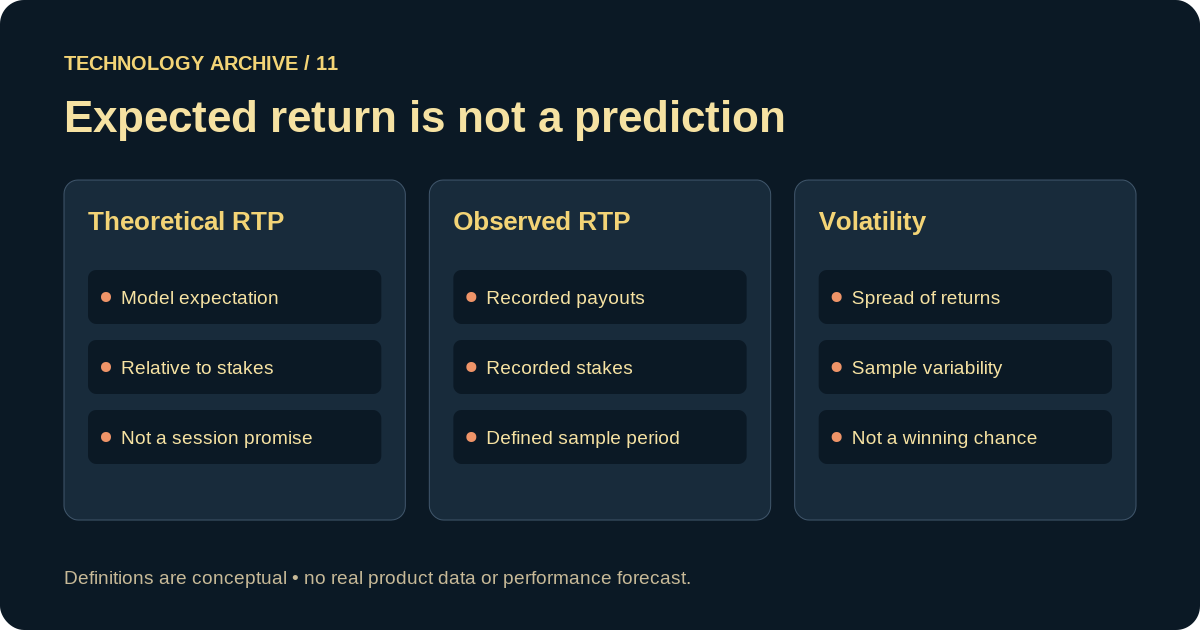
| Measure | Answers the question | Does not establish |
|---|---|---|
| Outcome probability | How likely is a defined event? | The next result |
| Theoretical RTP | What is the model's expected gross return relative to stakes? | Individual session return |
| Observed RTP | What return occurred in a specified sample? | Exact theoretical return from a small sample |
| Volatility | How variable are returns? | Whether an individual will win |
Under RTS 3, applicable games must provide information about their rules and likelihood of winning, with disclosure forms depending on the product. The purpose is to help consumers understand the product, not to imply that published percentages can be used to predict individual outcomes. [8]
Testing and Independent Verification
Statistical testing can examine whether observed values are consistent with an expected distribution. Such tests depend on the assumptions and sample size used. Passing a test does not prove that a generator is unpredictable, that every possible result is correct, or that the software cannot be manipulated. A useful assurance program distinguishes statistical evidence from implementation review and functional verification.
The Gambling Commission's testing strategy provides a concrete example of this distinction. Its approach and procedures cover independent examination of applicable RNG and game components, mathematical verification and checks of the implemented software against its stated rules. Testing may include simulation and manual examination in a representative environment. [9][10]
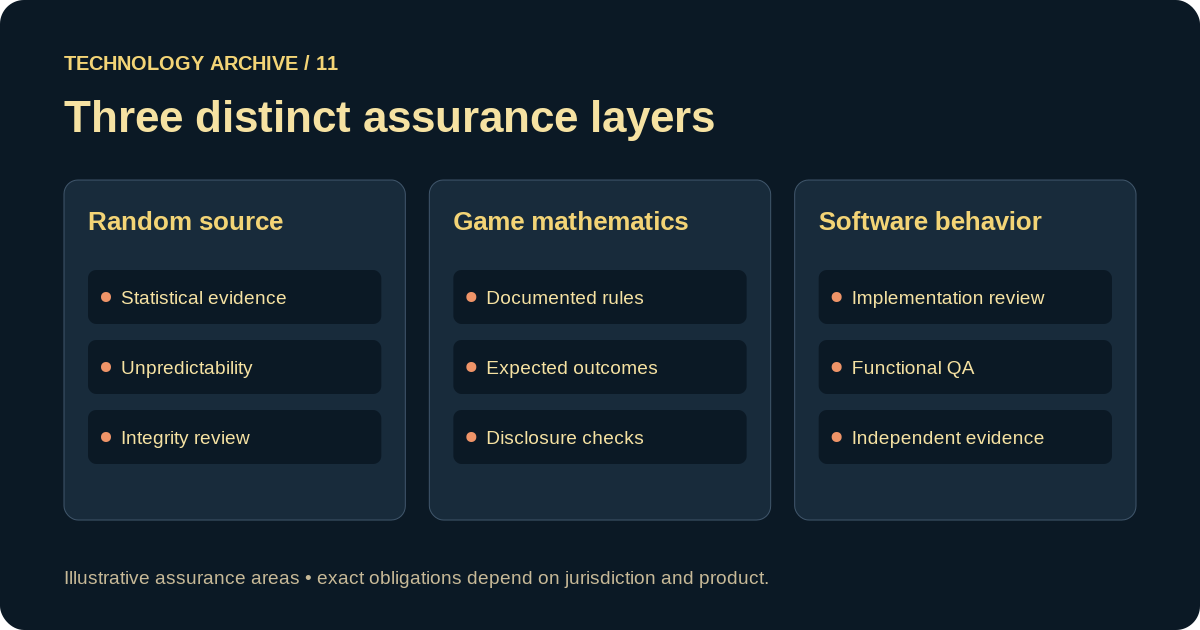
Internal QA remains important. It can identify defects in display, session recovery or discrepancies between recorded and presented results. Independent assessment addresses the relevant regulatory requirements and is not interchangeable with a developer's own QA sign-off. Auditability means retaining appropriate evidence about versions, assumptions and test scope; it does not require exposing confidential generator state to players.
Where Certification Starts
Certification begins with identifying the applicable jurisdiction, product category and obligations. Great Britain's RTS and testing strategy are examples, not a universal international rulebook. The slot game certification guide examines the separate roles of laboratories, regulators and software QA in more detail. The HTML5 slot game development overview discusses how these responsibilities fit into the wider production lifecycle.
The essential difference is therefore not that ordinary games use algorithms while slots use an entirely different kind of randomness. Both can rely on software generators. The difference lies in purpose, required outcome integrity, documented probabilities, disclosure and the independent evidence demanded by the applicable regulatory framework. A fair-looking animation or a random-looking sequence is not a substitute for that evidence.
Sources
- MDN — Random Number Generator
- MDN — Math.random()
- MDN — Crypto.getRandomValues()
- Godot — Random number generation
- Gambling Commission — RTS 7
- Gambling Commission — RTP key terms
- Gambling Commission — Live RTP monitoring
- Gambling Commission — RTS 3
- Gambling Commission — Testing strategy: approach
- Gambling Commission — Testing strategy: procedure